Collector Notes · September 25, 2026
Grand Seiko “Shunbun” SBGA413: What Makes This Spring Drive Reference Special
The Grand Seiko SBGA413 Shunbun pairs a pale pink seasonal dial with a 40 mm High-Intensity Titanium case and Spring Drive calibre 9R65.

The Grand Seiko Heritage Collection SBGA413, commonly known as “Shunbun,” brings together three of the brand’s clearest signatures: a nature-inspired dial, a modern interpretation of the 1967 62GS case and Spring Drive calibre 9R65.
Its pale pink dial receives most of the attention, but the watch is more than a color story. The SBGA413 uses a 40 mm High-Intensity Titanium case and bracelet, a box-shaped sapphire crystal, a screw-down crown and a movement rated to approximately 72 hours of power reserve. Understanding those details helps separate the exact reference from similar Grand Seiko models—and helps a buyer evaluate a pre-owned example properly.
The SBGA413 at a glance
• Collection: Grand Seiko Heritage Collection
• Reference: SBGA413
• Case and bracelet: High-Intensity Titanium
• Case dimensions: 40.0 mm diameter, 47.0 mm lug-to-lug and 12.8 mm thick
• Band width: 21 mm
• Crystal: Box-shaped sapphire with anti-reflective coating on the inner surface
• Case back: See-through, screw construction
• Crown: Screw-down

Photo credit: © Seiko Watch Corporation. Image courtesy of Grand Seiko — Source: https://www.grand-seiko.com/us-en/collections/sbga413g
• Water resistance: 10 bar
• Magnetic resistance: 4,800 A/m
• Movement: Spring Drive calibre 9R65, self-winding with manual winding
• Power reserve: Approximately 72 hours
• Manufacturer-stated accuracy: ±15 seconds per month, or approximately ±1 second per day
• Functions: Time, date, power-reserve indication and hacking seconds
• Weight: 102 grams
Why it is called Shunbun
“Shunbun” refers to the vernal equinox in Japan’s traditional system of twenty-four seasonal periods, or *sekki*. Grand Seiko describes the dial as an interpretation of *hana-ikada*: fallen cherry-blossom petals floating and swirling on water soon after the spring equinox.
That explanation is important because the dial is not intended to be a flat, saturated pink. Its pale color and textured surface change with the light. In some conditions the pink is obvious; in others it can appear nearly silver. Anyone buying remotely should ask for neutral-light photographs and video rather than relying on a heavily edited listing image.
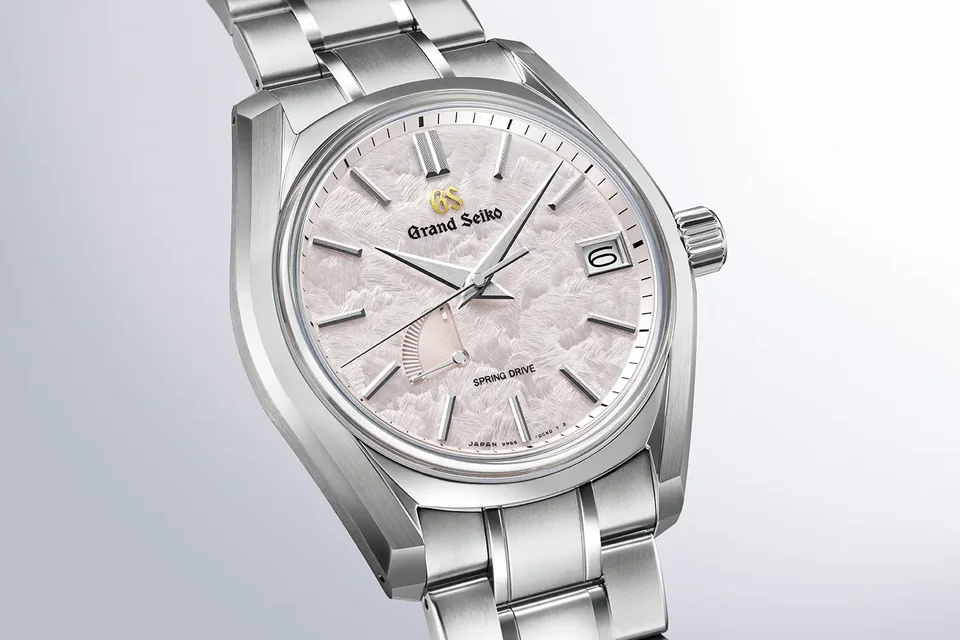
Photo credit: © Seiko Watch Corporation. Image courtesy of Grand Seiko — Source: https://www.grand-seiko.com/us-en/collections/sbga413g
The 62GS design connection
Grand Seiko identifies the SBGA413 as a modern reinterpretation of the 62GS introduced in 1967. The historical model was the first automatic Grand Seiko and was recognized for its bezel-free construction, broad dial opening and multi-sided case.
On the SBGA413, the crystal appears to meet the case without a conventional external bezel framing the dial. This gives the dial greater visual presence while leaving the angular case surfaces exposed. Grand Seiko highlights Zaratsu polishing as essential to the sharp edges and distortion-free reflective surfaces of the design.
Those polished planes are part of the watch’s appeal—and a major inspection point. On a pre-owned example, look for softened transitions, rounded case edges or inconsistent surfaces that may indicate aggressive refinishing.
High-Intensity Titanium changes the wearing experience
The SBGA413’s case and bracelet are made from Grand Seiko’s High-Intensity Titanium. At a manufacturer-listed 102 grams, it delivers a notably lighter package than many similarly sized steel watches.
The 40 mm diameter tells only part of the fit story. Its 47 mm lug-to-lug span, 12.8 mm thickness and wide, bezel-free dial opening all influence how large it appears on the wrist. Buyers should consider all three dimensions—and ideally try on the watch—rather than assuming every 40 mm case wears the same way.
Titanium also has its own surface character. The combination of polished and brushed areas should remain crisp. Scratches alone are not necessarily a problem, but uneven restoration work can permanently alter the case geometry.
Understanding Spring Drive calibre 9R65
Calibre 9R65 is powered by a mainspring and winds automatically, with manual winding also available. Spring Drive differs from a conventional mechanical escapement: the movement’s gear train generates a small electrical charge that powers an integrated circuit and quartz oscillator, with no battery or external power source.
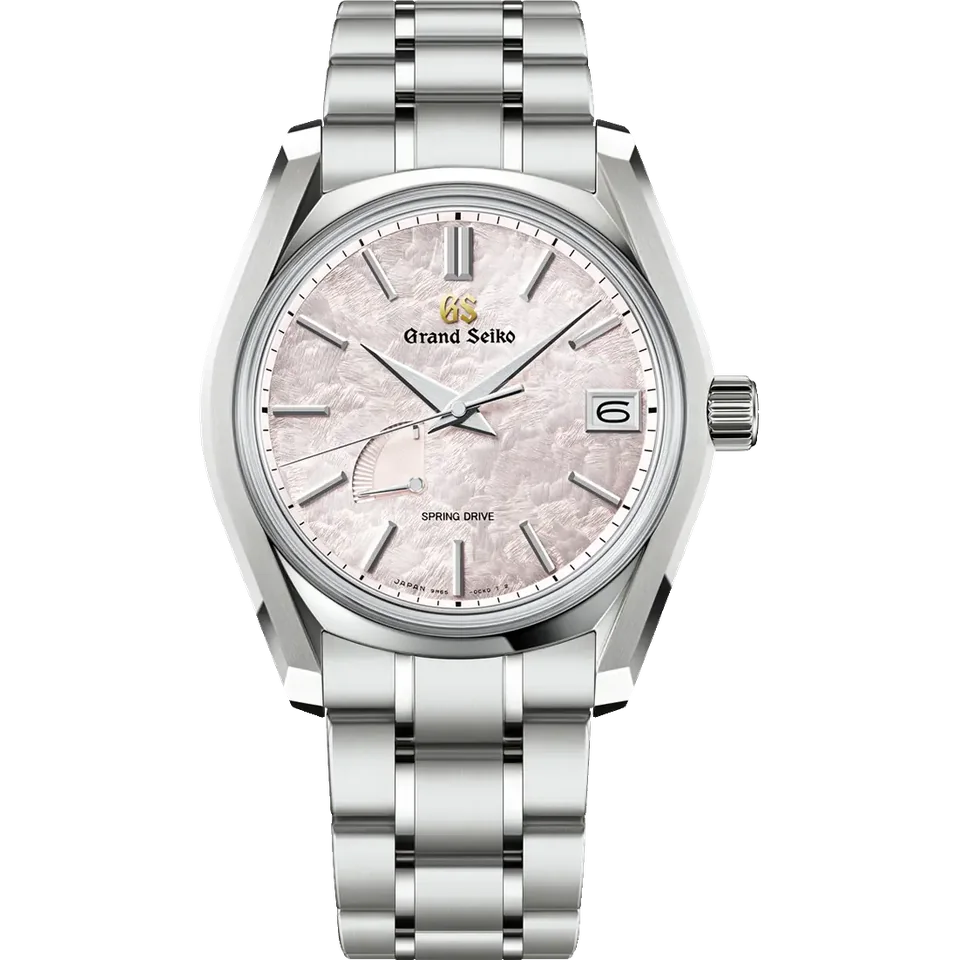
Photo credit: © Seiko Watch Corporation. Image courtesy of Grand Seiko — Source: https://www.grand-seiko.com/us-en/collections/sbga413g
For the owner, the practical results are a continuously gliding seconds hand and a manufacturer-stated accuracy of ±15 seconds per month. The movement also provides approximately 72 hours of reserve, a date display, a power-reserve indicator and hacking seconds for precise setting.
Grand Seiko states that the 9R65 in the SBGA413 is assembled at the Shinshu Watch Studio. The exhibition case back allows the owner to see the movement, but the display back is also an inspection point: check the sapphire, perimeter, screws and surrounding titanium for damage or careless tool marks.
What to inspect when buying pre-owned
1. Confirm the exact reference. The watch covered here is SBGA413. Do not substitute specifications or images from the grey-dial SBGA415 or another 62GS-style model.
2. Evaluate the dial under neutral light. Ask for clear, unfiltered images and video. The subtle pink can be exaggerated by lighting, white balance and editing.
3. Inspect the case geometry. Look closely at the transitions between brushed and polished surfaces, especially around the lugs and case flanks.
4. Check Spring Drive performance. Observe the seconds hand, test hand-setting and hacking, and compare timing over several days with the manufacturer’s stated tolerance.
5. Test the date and power-reserve display. Confirm that the date changes correctly and the reserve indicator responds as the watch winds and runs down.
6. Inspect the bracelet and clasp. Verify that enough original links are present, the push-button clasp closes securely and the bracelet matches the condition represented.
7. Review service history. Spring Drive servicing should be handled by a qualified facility familiar with calibre 9R65. Documentation is more useful than an unsupported claim that the watch was “recently serviced.”

Photo credit: “Grand Seiko SBGA413” by carpathiar, via Flickr, licensed CC BY-ND 2.0 — Source: https://www.flickr.com/photos/24300714@N04/52239337029/
The Rallo view
The SBGA413 works because its design and mechanics reinforce each other. The seasonal dial gives the watch identity, while the lightweight titanium case and accurate Spring Drive movement make it practical enough for frequent wear.
It is best for a buyer who values subtle color, Japanese design language and the hybrid engineering of Spring Drive. A buyer seeking a conventional Swiss-style mechanical movement, a heavier steel feel or a dial that looks identical in every photograph may prefer another reference.
The essential buying rule is simple: judge the actual watch, not the nickname. Confirm SBGA413, inspect the titanium finishing carefully and view the Shunbun dial in honest lighting before deciding.
Sources reviewed
• Grand Seiko, *SBGA413*: https://www.grand-seiko.com/id-id/collections/sbga413g
• Grand Seiko, *Japan Seasons Special Edition*: https://www.grand-seiko.com/us-en/special/japanseasons
• Grand Seiko, *Twenty-Four Seasons announcement* (September 30, 2019): https://www.grand-seiko.com/us-en/news/20190930
• Grand Seiko, *Calibre 9R65*: https://www.grand-seiko.com/ph-en/collections/movement/springdrive/9r65
Facts checked September 15, 2026. Manufacturer specifications describe the reference; every pre-owned example requires its own condition, authenticity and performance review.