Omega Reviews · October 20, 2026
Omega Speedmaster Moonphase 304.30.44.52.01.001 Review
Four original owner photographs examine the black-dial Omega Speedmaster Moonphase 304.30.44.52.01.001, its proportions, functions and pre-owned buying checks.
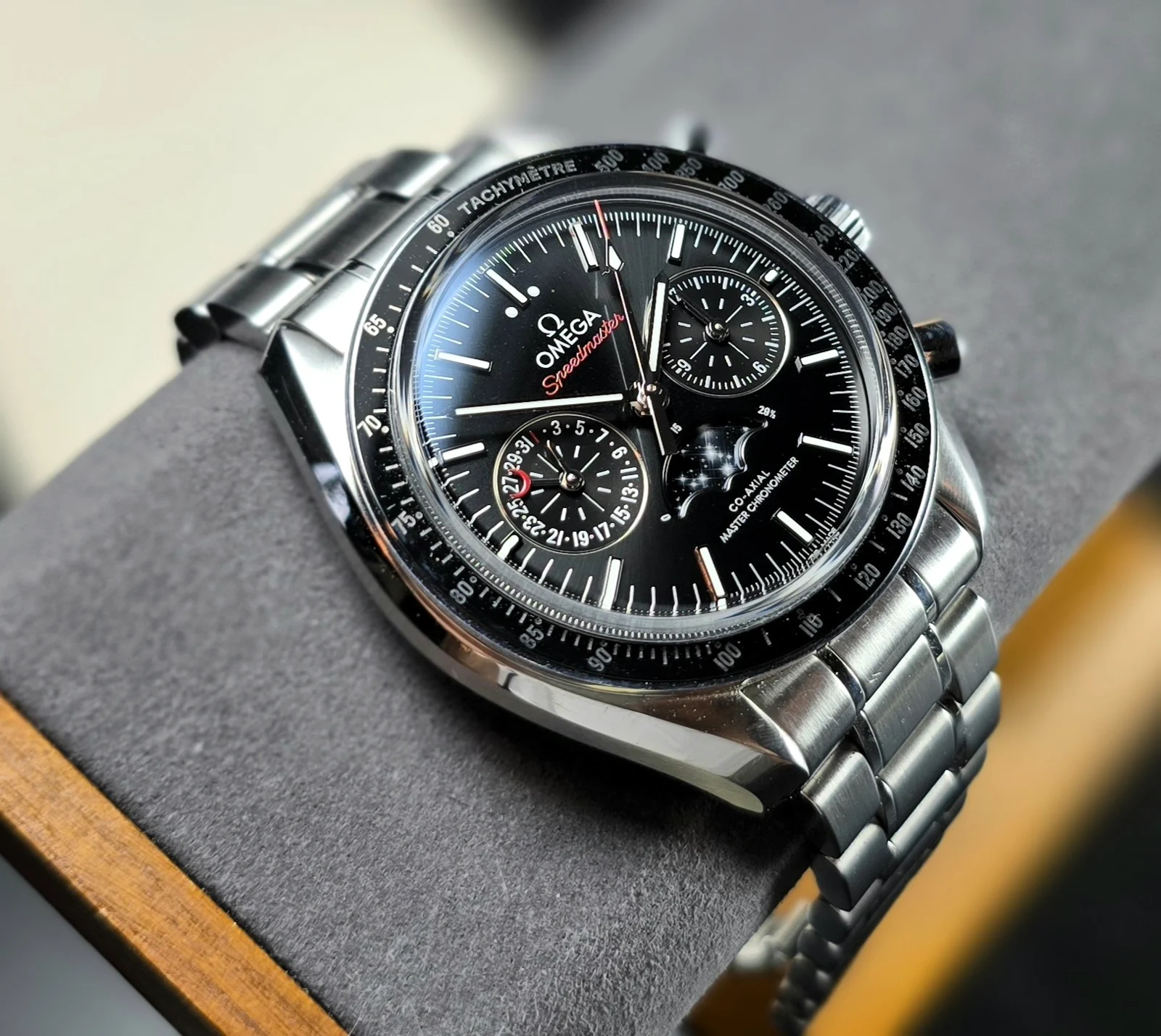
The Omega Speedmaster Moonphase reference 304.30.44.52.01.001 puts a small astronomical display inside a much more assertive watch. In Ron King’s original photographs, the black dial and bezel form a dark centre, interrupted by silver-toned hands, bright hour markers and the red Speedmaster signature. The steel bracelet makes the whole composition feel substantial before the dimensions enter the discussion.
This review examines the black-dial, steel-bracelet configuration shown in four owner-archive photographs. It does not announce that the photographed watch is currently for sale. Reference identification was checked against private documentation, which remains unpublished.
What the reference actually offers
Omega’s exact-reference product information specifies a 44.25 mm steel case, a black sun-brushed dial, a black ceramic bezel with a Liquidmetal tachymeter scale, and a steel bracelet. The automatic calibre 9904 combines a chronograph, date and moonphase display; Omega lists a 60-hour power reserve and Master Chronometer certification.
The same specification lists 50 mm lug-to-lug, 16.85 mm thickness, a 21 mm lug spacing and a 10 bar water-resistance rating. These are manufacturer specifications, rather than measurements or test results for Ron’s individual watch.
Those proportions make an in-person fit check worthwhile. A buyer should try the watch with the bracelet adjusted, move the wrist through ordinary positions and check clearance under the clothing they actually wear. A display cushion cannot answer those questions.
Read the dial before judging its complexity
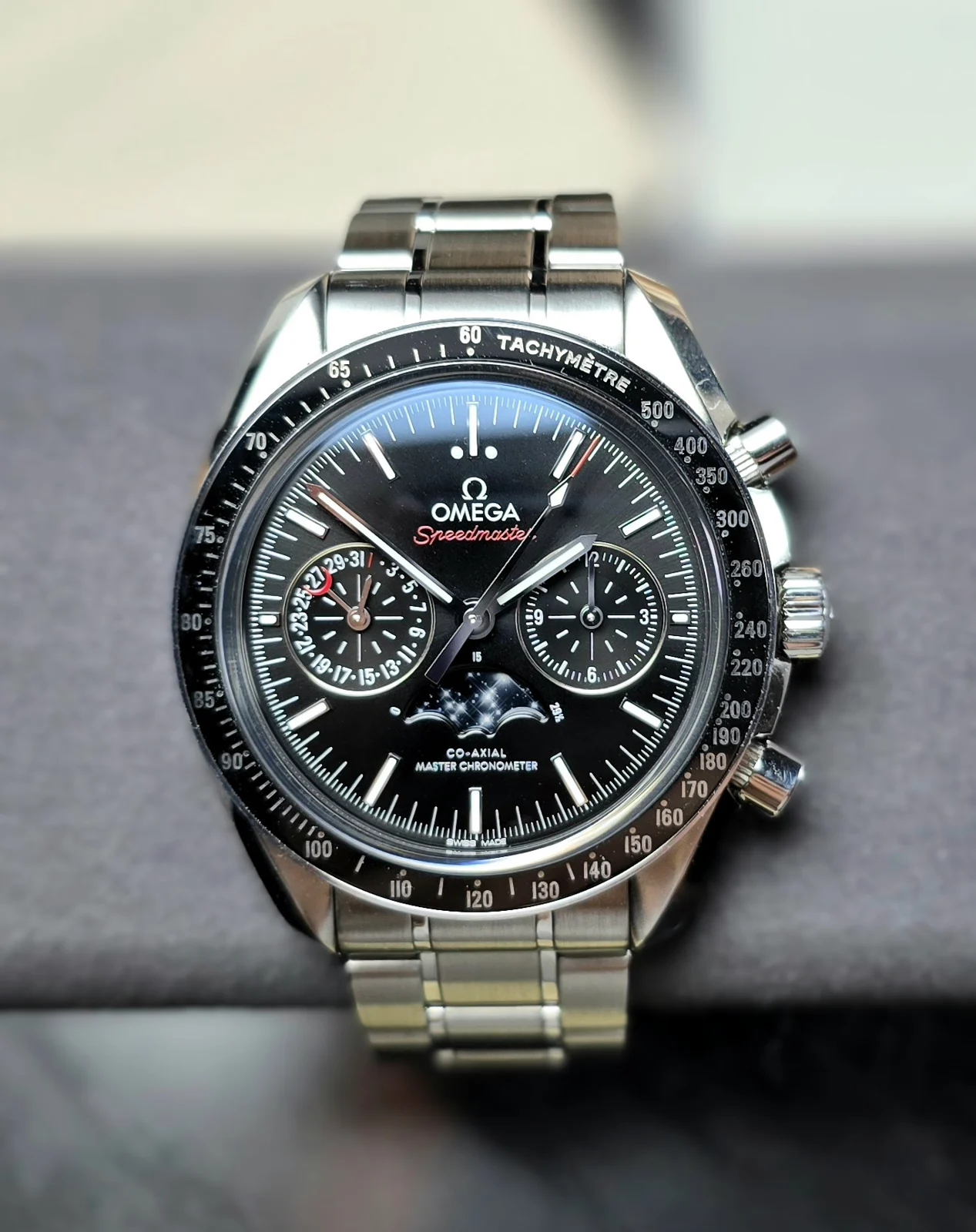
The frontal photograph is the best place to learn the arrangement. The left subdial carries a numbered calendar scale and a red-tipped pointer; the right subdial has two concentric scales. Below them, the moonphase aperture introduces a different kind of detail: a starry scene rather than another ring of graduations.
There is considerable information here, but the large hour markers give the eye a consistent outer framework. In the oblique photograph, the bright hands and markers stand apart from the dark dial. The moonphase display becomes a point of interest after the time, rather than competing with every other element at once.
For a prospective purchase, ask for a straight-on photograph in even light as well as an angled view. The two images serve different purposes. One helps compare printing and hand positions; the other shows the effect of reflections across the crystal and polished surfaces.
The side view changes the conversation
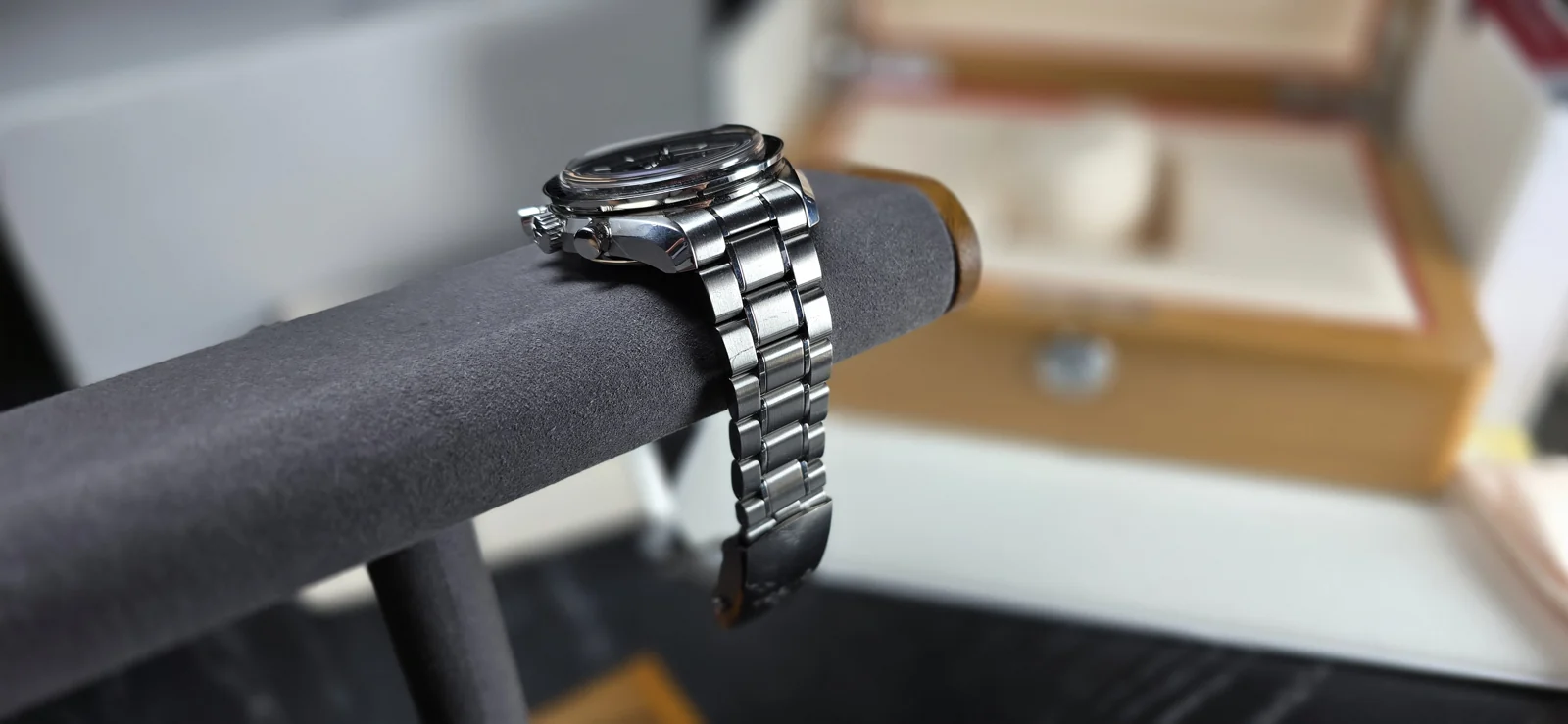
The case-profile photograph is particularly useful. It reveals the raised crystal, layered case outline, crown and adjacent pusher more clearly than the frontal view. The upper bracelet links also show how the watch connects to the wrist.
Inspect those areas separately. Ask about scratches, impacts, refinishing and replacement components, and request photographs of both case flanks and the clasp. A bright reflection can hide an edge just as easily as it can highlight one. These images support a visual discussion; they do not establish an untouched case or authenticate every component.
The bracelet’s alternating surface finishes are especially apparent in the oblique view. Before buying, confirm the included-link count and usable fit range. A photograph of a watch with a closed bracelet is not a substitute for those measurements.
Certification and current condition answer different questions
METAS describes Master Chronometer certification as covering accuracy under specified influences, power reserve and water resistance. That is useful technical context. It does not establish the present condition of a previously owned example.
Request a demonstration of the chronograph starting, stopping and resetting, together with evidence of the date and moonphase functions operating correctly. Obtain the exact-reference operating instructions before changing settings. This review does not prescribe a setting sequence from a different Speedmaster.
Omega’s care and operating guidance recommends regular water-resistance checks. Its original rating should not be treated as a fresh pressure-test result. Ask what work was performed at the last service and what documentation supports it.
What the boxed photograph tells you
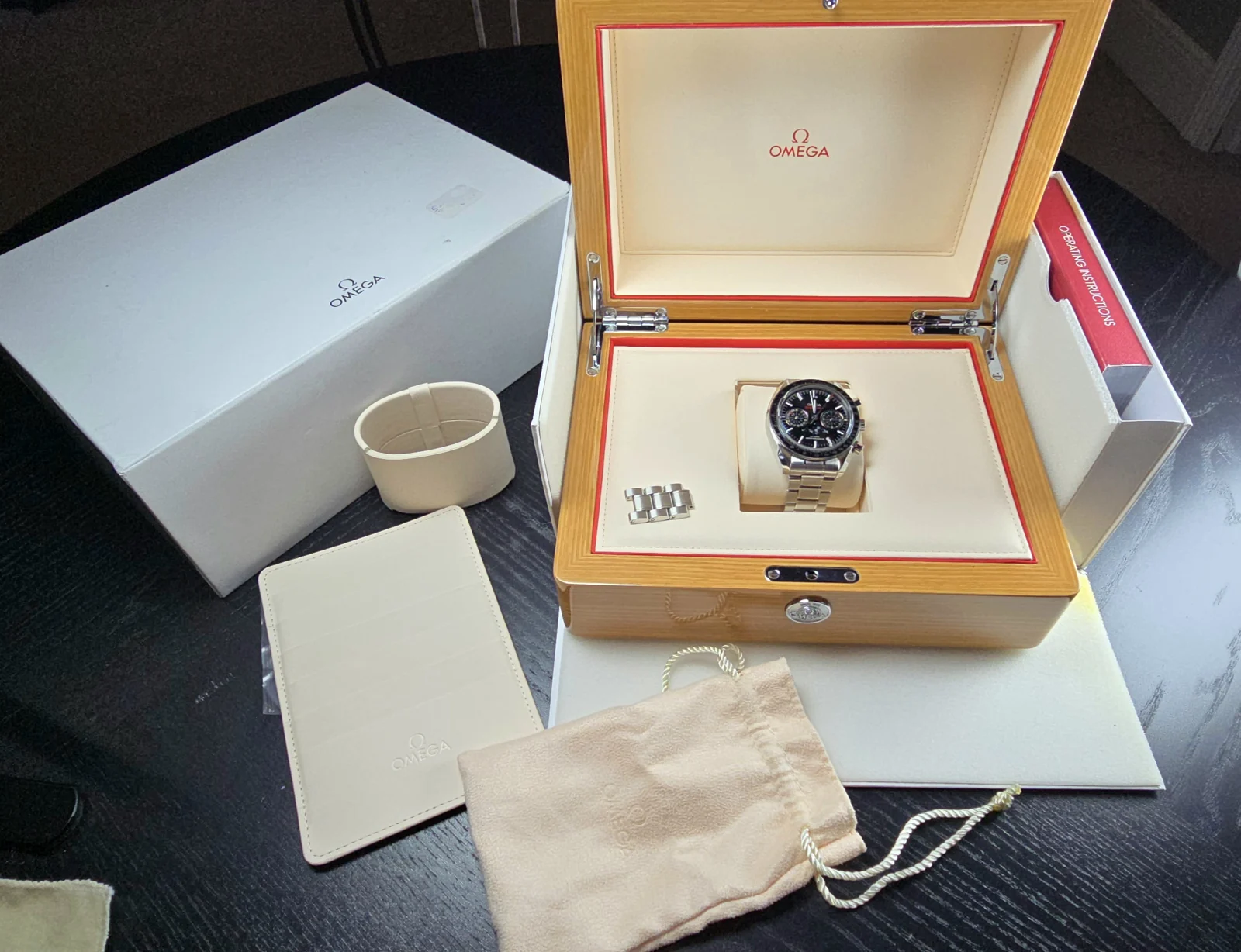
The fourth photograph records the watch in an open wooden presentation box, with spare links and accessories around it. This is useful archive context, but it is not a promise that every pictured item accompanies a future transaction.
Confirm the actual contents individually. Match the reference and identifying details privately, read the service history, and ask for a current list of included accessories. Keep warranty access codes and personal information out of public photographs.
Rallo’s buyer information explains the inquiry process. For a contrasting calendar display, see the Jaeger-LeCoultre Master Calendar Q1552540 review.
Verdict
The appeal of this Speedmaster is the combination visible across the photographs: an expansive black dial, purposeful case profile and a moonphase scene that softens the surrounding scales. Its size and complexity are central to the buying decision.
Start with fit, then examine condition and function. A well-documented example should answer those questions as convincingly as its frontal photograph attracts attention.
Sources and checks: October 17, 2026
- Omega exact-reference product information: configuration, dimensions, movement, power reserve and original rating. Official primary-source text was available in web search; direct page retrieval was unavailable.
- METAS watch certification: certification scope.
- Omega operating-instruction finder and technical care guidance: reference-specific instructions and care resources. No detailed setting procedure is reproduced.
- Primary visual evidence: four photographs from Ron King’s own watch archive. Private reference documentation was checked; its image and identifiers are excluded.
Photography and rights
All four photographs: Ron King / Rallo Watches. These are original owner-archive photographs; commercial editorial reuse by Rallo is authorized under Ron’s standing instructions for his own originals.
Lead: oblique dial and bracelet view. Supporting views: frontal dial, case profile and boxed watch with accessories. The publication copies preserve proportions, are compressed and resized, and have metadata removed. No watch feature is generated, replaced or retouched.