Rolex Reviews · October 10, 2026
Rolex Daytona 116523 Blue Racing Dial Review: Condition Is the Story
A buyer-focused review of the Rolex Daytona 116523 with a blue racing dial, two-tone Oyster bracelet, calibre 4130 and honest wear.
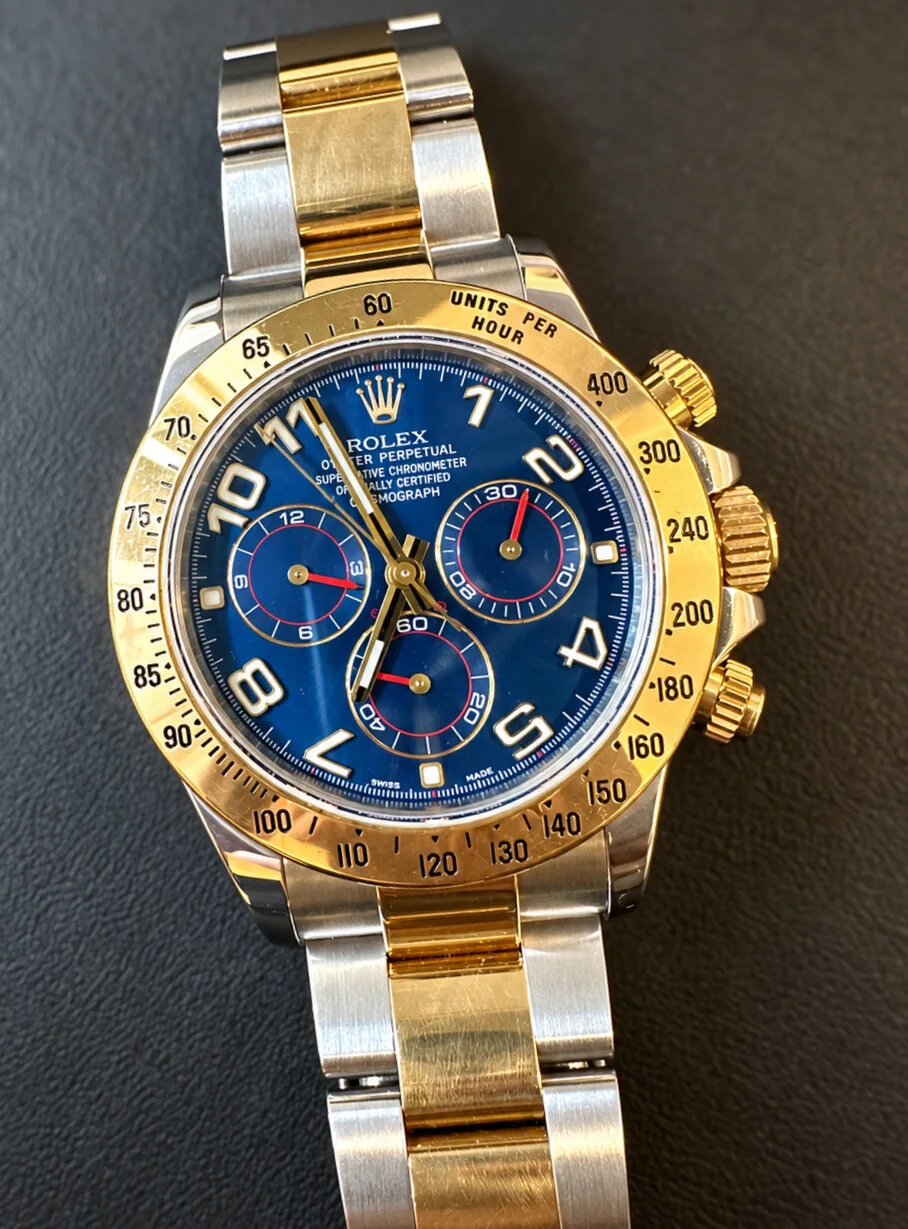
The Rolex Cosmograph Daytona reference 116523 is easy to reduce to a shorthand: the two-tone Daytona. The watch photographed here deserves a more careful reading. Its blue Arabic-numeral “racing” dial, yellow-gold tachymeter bezel and steel-and-yellow-gold Oyster bracelet create a distinctive configuration. Its surfaces also show real wear. That combination makes it useful for buyers because it reveals where the character—and the questions—actually live.
This is a collector review, not a sale listing or a blanket claim about component originality. The photographs show the exact reference and configuration reviewed. A buyer should still reconcile the dial, bracelet, clasp and service history with the watch’s records and a qualified inspection.
What the photographed 116523 gets right
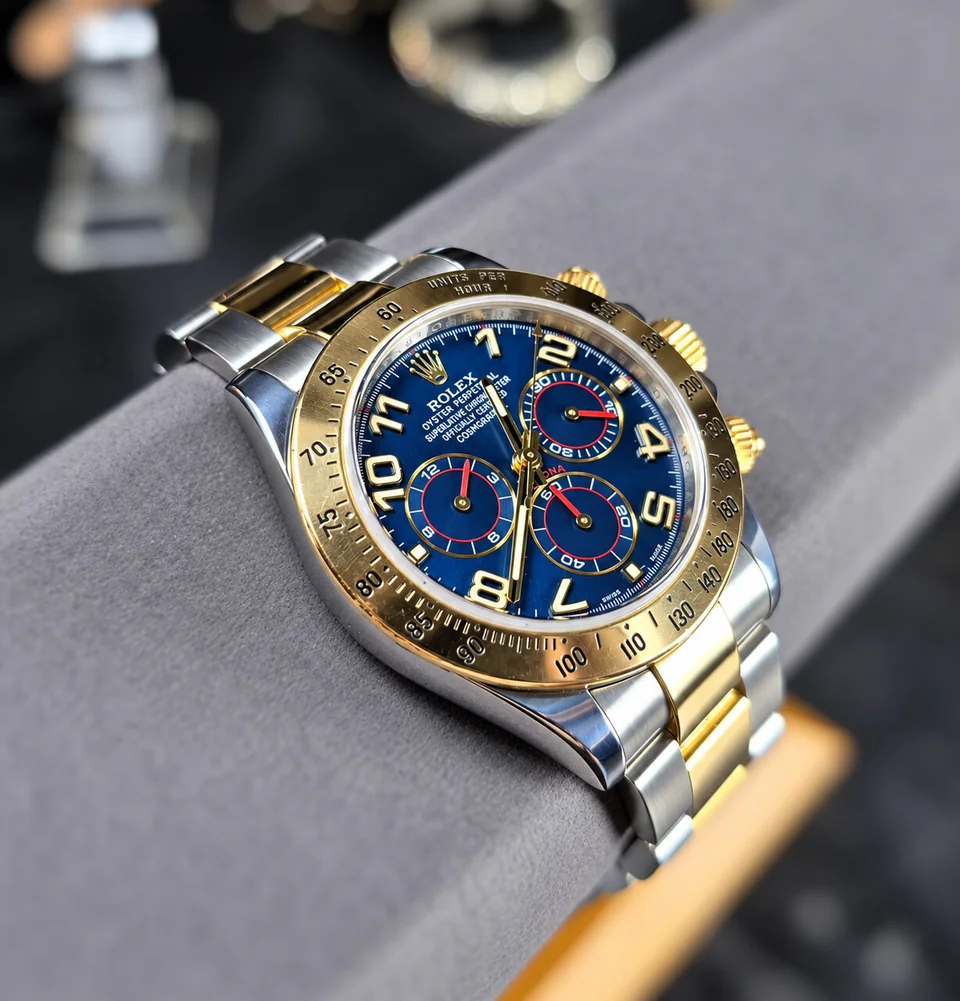
The blue dial changes the familiar two-tone formula. It is cooler and less formal than champagne, while the yellow-gold bezel, crown, pushers and center links keep the Daytona’s jewelry side in view. Red accents around the outer scale and registers add visual energy without changing the basic chronograph layout.
The case proportions are another reason this generation remains approachable. Rolex’s Daytona literature identifies the model family with a 40 mm Oyster case, and this watch has the compact, low-profile presence collectors associate with the six-digit, metal-bezel generation. The fixed tachymeter scale, screw-down chronograph pushers and guarded crown make its purpose clear before the dial is read.
Those pushers matter mechanically as well as visually. Rolex’s official Daytona user guide instructs the wearer to unscrew them before operating the chronograph and to screw them down again afterward. The upper pusher starts and stops timing; the lower pusher resets the hands. On a pre-owned example, the action should feel positive and consistent. Sticky operation, uneven resistance or a reset that does not return every hand precisely to zero deserves investigation rather than rationalization.
Calibre 4130 is the central technical fact
Rolex says it developed and manufactured calibre 4130 for the Cosmograph Daytona in 2000. The company specifically highlights a reduced component count for the self-winding chronograph. That date matters for the 116523: this reference belongs to the in-house-movement era, not the preceding Zenith-based generation.
For a buyer, the architecture is less important than behavior. Wind the watch properly, then observe timekeeping and the chronograph through repeated start, stop and reset cycles. Check that the central seconds hand tracks cleanly and that the register hands return to their zero positions. Ask what service was performed, by whom and which parts were replaced. “Recently serviced” is not enough without supporting detail.
Rolex’s current service description explains that a complete service separates and examines the movement, case and bracelet, replaces components that no longer meet requirements, lubricates the rebuilt movement and finishes with tests of function, waterproofness, power reserve and precision. That is a useful benchmark for evaluating an invoice, even if an independent watchmaker performed the work.
Read the wear before you judge it
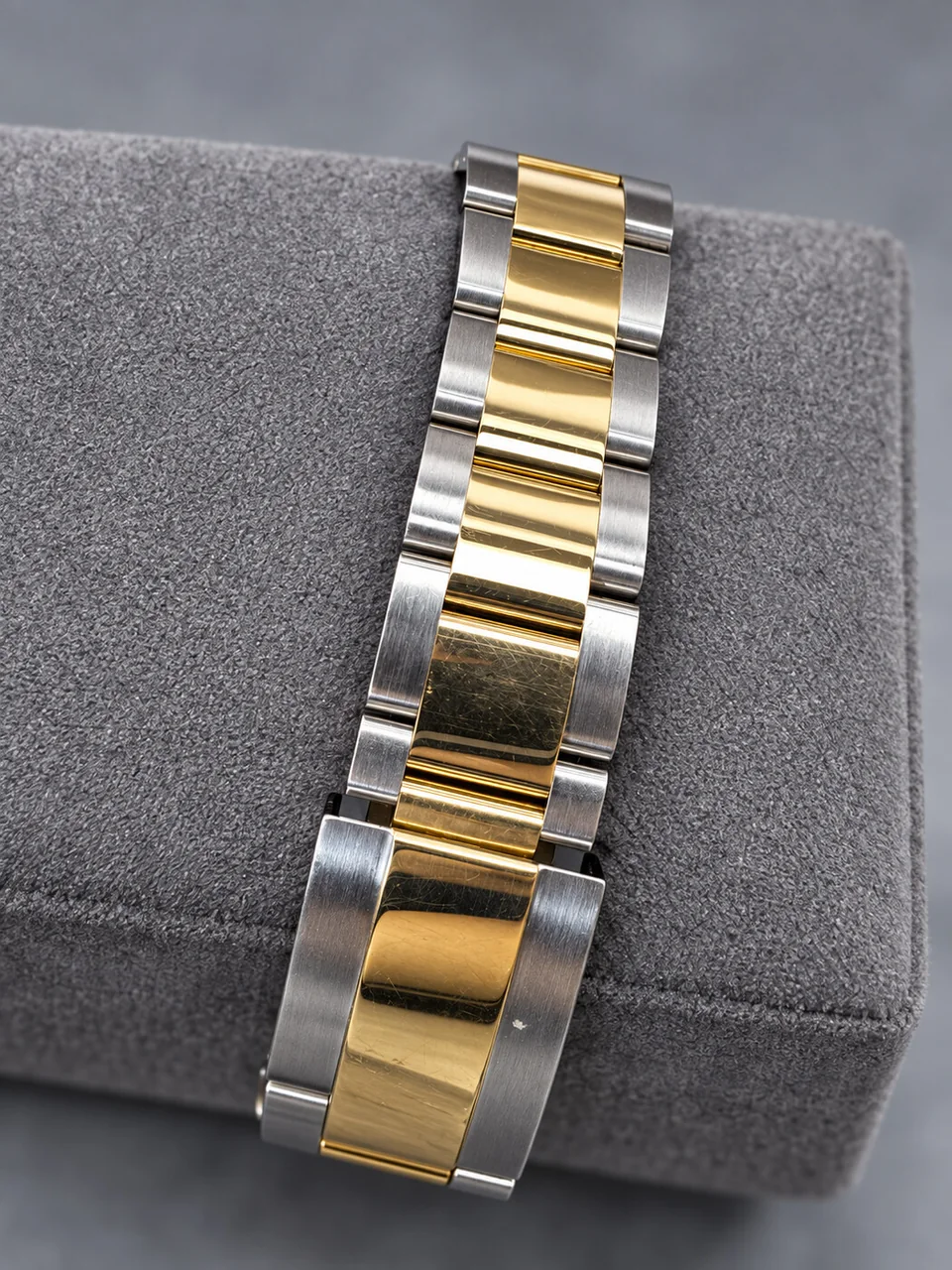
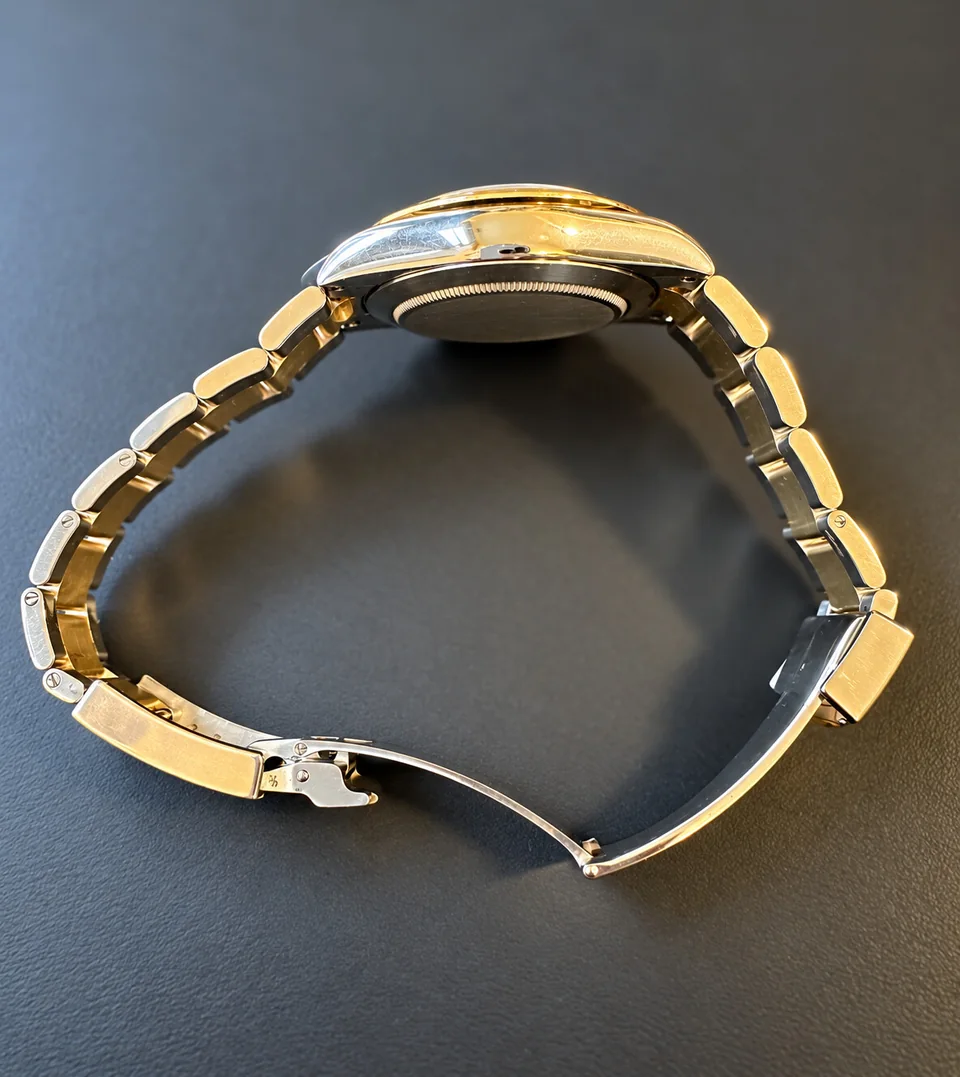
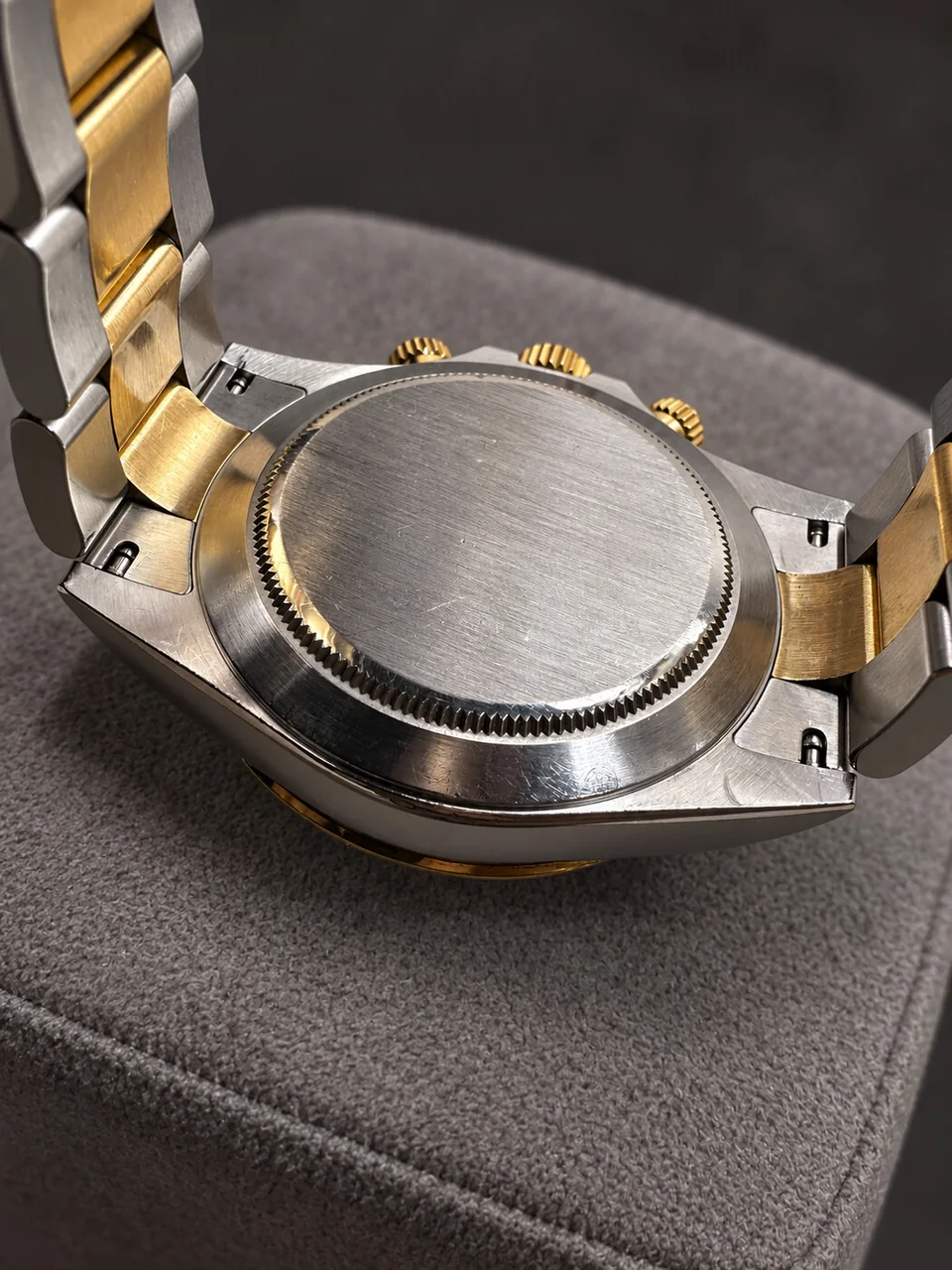
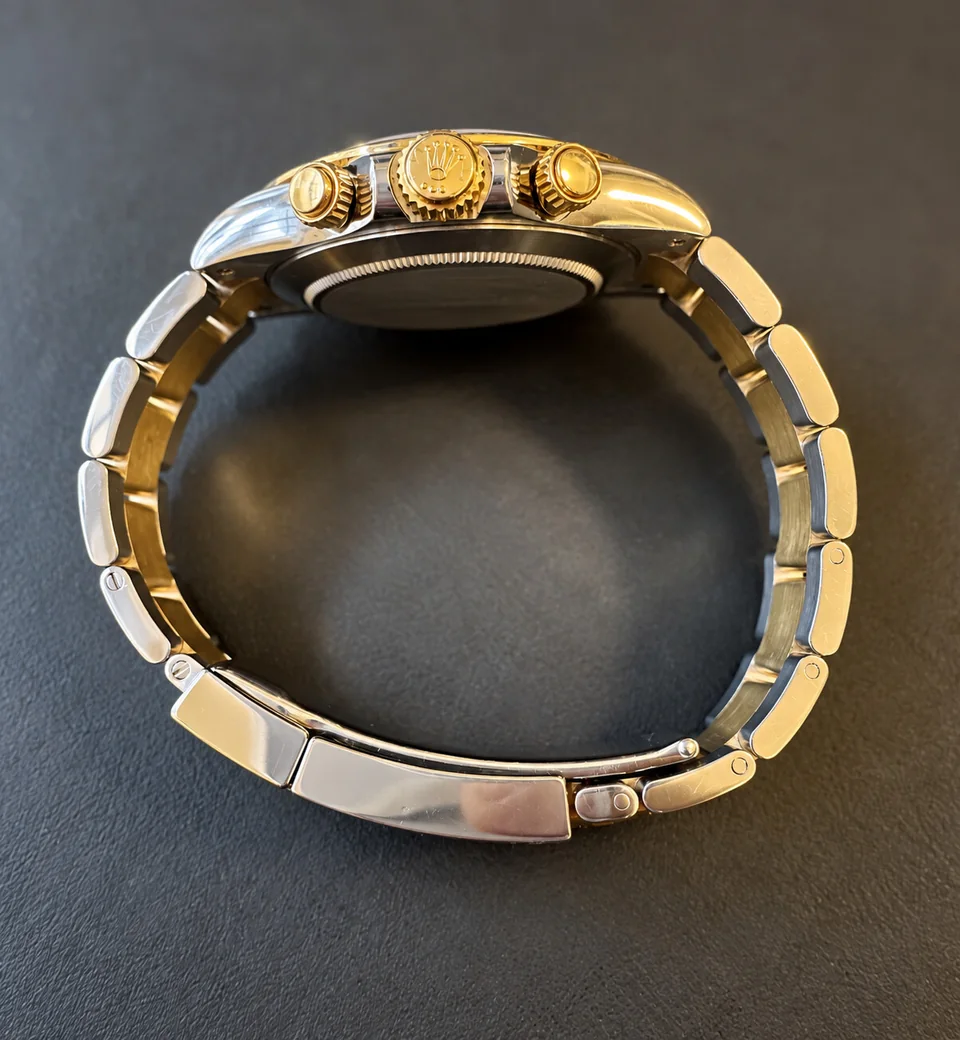
The photographs are especially valuable because they do not hide normal use. Fine marks are visible on the polished gold center links, clasp, case sides and solid caseback. The brushed outer links retain their directional finish. The crown-and-pusher side shows the transitions between polished and brushed surfaces clearly.
Honest wear is not automatically a defect. For many collectors it is preferable to a watch whose geometry has been softened by repeated refinishing. The important question is whether the wear is consistent with ordinary use and whether the case still preserves its lines. Look at the lugs from above and from the side, the edges around the crown guards, the relationship between bezel and mid-case, and the evenness of the bracelet’s brushed surfaces.
The gold tachymeter bezel needs close inspection under angled light. Because its numerals and surface are visually prominent, aggressive polishing can materially change the watch’s appearance. Compare the bezel’s edge, engraving depth and surface to known-correct examples, but do not authenticate from photographs alone.
Bracelet condition deserves equal attention. Hold the watch horizontally to assess articulation and possible stretch. Inspect the junctions between steel and gold links, screw heads, end links, clasp blade and safety components. A refinished bracelet can look sharp in one front-on image while revealing far more from the underside. The six views in this review are intentionally varied for that reason.
Treat the blue racing dial as a provenance question
The photographed dial is a major part of the appeal, but it should also be a specific line item in due diligence. Confirm that the dial configuration is appropriate for the reference and production period, then determine whether it was delivered with the watch, added during an authorized service or changed later. Papers, service records and a Rolex assessment may help establish that history.
Do the same for the hands. Check style, lume color, alignment and surface condition under magnification. A visually convincing set is not proof of originality, and a service replacement is not necessarily undesirable. What matters is that the buyer knows what is present and pays accordingly.
This discipline is useful across modern Rolex collecting. Our Rolex GMT-Master II 116710BLNR review takes a similar approach to generation-specific details, while the Rolex Air-King 126900 review shows how a later reference should be assessed on its own design and technical context.
Water resistance is a test result, not a permanent promise
Rolex’s Daytona guide describes a 100-metre waterproof rating when the crown and pushers are completely screwed down. That factory specification should not be confused with the present condition of a pre-owned watch. Gaskets age, components may be opened during service and impacts can affect sealing.
Before exposing any pre-owned Daytona to water, obtain a current pressure-test result from a qualified watchmaker. Make sure the crown and pushers thread smoothly and seat correctly; never force them. Rolex also advises ensuring that the crown is screwed down before cleaning and recommends fresh-water rinsing after seawater exposure. On an older watch, follow those care instructions only after present water resistance has been verified.
What to check before buying
A careful pre-purchase inspection should answer these questions:
- Does the case reference match the watch’s records, and can identifying numbers be verified confidentially?
- Is the blue racing dial documented as original delivery, authorized-service replacement or later change?
- Do the chronograph start, stop and reset functions operate correctly through repeated cycles?
- Do the crown and pushers screw down smoothly, with no cross-threading or excessive resistance?
- Does the case retain clear geometry, or has refinishing softened edges and transitions?
- What is the condition of the gold bezel engraving and the steel-and-gold bracelet?
- Is there a movement-service record, and what parts were replaced?
- Has the watch passed a current water-resistance test?
- Are box, papers, tags and service records original to this exact watch rather than assembled later?
A trustworthy seller should welcome those questions. If the watch cannot be inspected in person, request sharp, current photographs of the dial, rehaut, case profile, crown-and-pusher side, caseback, clasp, bracelet articulation and supporting documents—with sensitive numbers shared only through a secure private channel.
Who this Daytona is for
The 116523 is for someone who wants the motorsport identity and mechanical seriousness of the Daytona without pretending it is a monochrome tool watch. The blue racing dial is expressive, the steel-and-gold construction is unmistakable, and the metal tachymeter bezel anchors it in an earlier six-digit Daytona era.
The photographed example also illustrates a sensible collecting priority: buy the watch, not the fantasy of an untouched object. Condition, component history, mechanical function and documentation are more useful than a vague grade such as “excellent.” A worn but coherent and well-documented watch can be easier to understand than an over-refinished one with a thin story.
Verdict
The Rolex Daytona 116523 blue racing dial succeeds because its contrasts are deliberate: cool blue against yellow gold, a technical chronograph inside a luxurious exterior, and a highly recognizable design that still rewards close inspection. The movement story is strong, but the buyer’s decision should turn on the exact watch—especially dial provenance, case geometry, bracelet condition, service history and water-resistance testing.
This example is not presented as flawless. It is presented clearly enough to ask better questions.
Primary sources checked October 10, 2026
Photography and rights
All six photographs are original images from Ron King’s Rallo Watches owner archive. Commercial publication by Rallo is authorized. The set includes the dial and bezel, an angled hero view, bracelet finishing, underside and clasp, solid caseback, and crown-and-pusher side. No manufacturer images, stock photography, AI-generated imagery or substituted references were used.