Vintage Rolex · September 8, 2026
Rolex Explorer 6610: Why This Mid-Century Reference Matters
Rolex’s 1955 Explorer 6610 paired a 36 mm steel case with calibre 1030, helping define the slimmer Explorer form collectors recognize today. Here is why individual originality matters most.
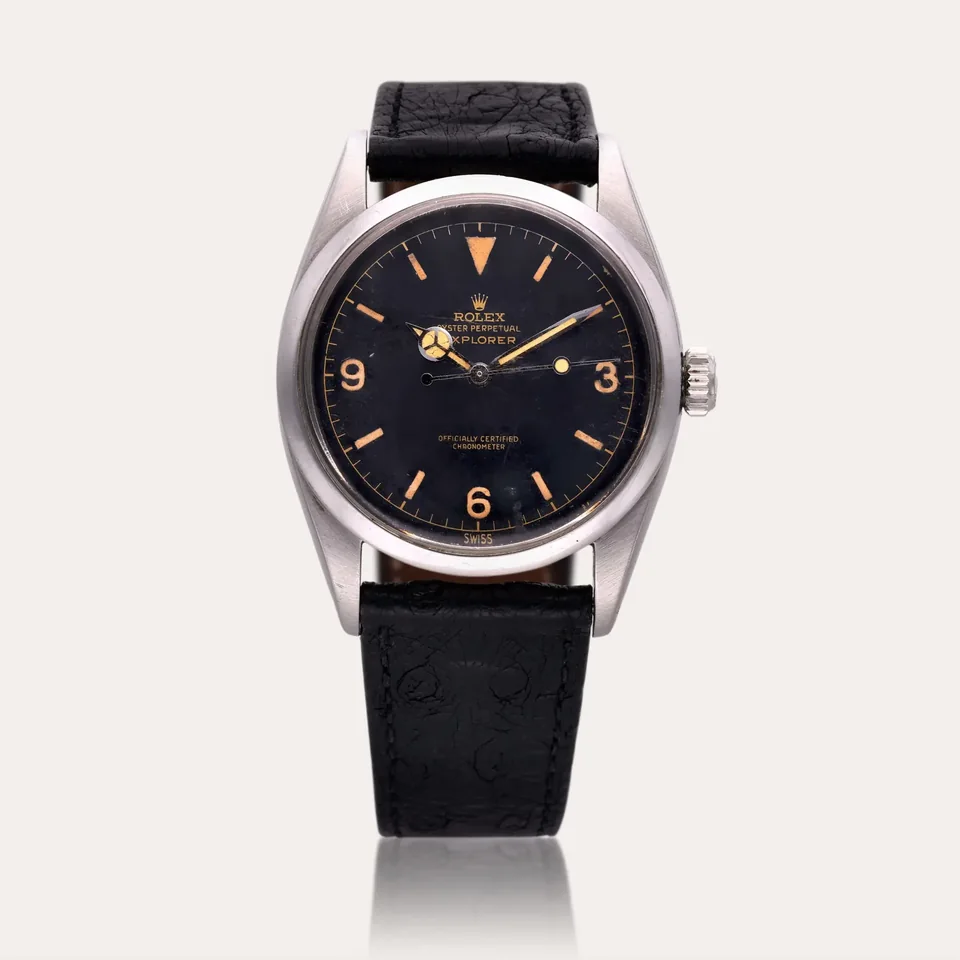
The Rolex Explorer reference 6610 occupies a small but important place in the history of the model. It arrived after the Explorer’s 1953 debut and before the long-running reference 1016, helping establish the slim, highly legible form that collectors still associate with the Explorer.
For Rallo Watches, the appeal is straightforward: the 6610 is not a modern watch wearing vintage styling. It is one of the early references that helped define that styling in the first place.
Where the 6610 fits in the Explorer story
Rolex says the Explorer was created in the wake of the first confirmed ascent of Mount Everest in 1953. Sir Edmund Hillary and Tenzing Norgay reached the summit on May 29 as members of the British expedition led by Sir John Hunt; Rolex describes the expedition as being accompanied by Oyster Perpetual chronometers. Later that year, the company unveiled the Explorer with the now-familiar 3, 6 and 9 numerals, baton markers and triangle at 12 o’clock.
Specialist auction records from Phillips place the introduction of reference 6610 in 1955. The reference followed earlier Explorer-era watches fitted with the thicker calibre A296. Its slimmer automatic calibre 1030 allowed Rolex to use a flatter case back and create a more streamlined profile.
That mechanical change is one reason the 6610 matters. It helped move the Explorer away from the more rounded “bubble-back” profile of earlier watches and toward the shape that became familiar on later references.
The recognizable 6610 formula
Documented auction examples identify the 6610 as a stainless-steel, automatic, time-only Explorer measuring approximately 36 mm. Its black dial uses the Explorer’s defining layout: Arabic numerals at 3, 6 and 9, a triangle at 12 and baton markers between them.
The movement is the automatic Rolex calibre 1030. Phillips records describe examples with 25 jewels, while multiple catalogues specifically connect the thinner calibre to the 6610’s flatter case back.
The familiar details should not be treated as a rigid checklist for every surviving watch. The 6610 appeared with dial variations, and nearly seven decades of aging, servicing and restoration can materially change an individual example.
Dial variation is part of the story
Some of the most discussed 6610 watches carry a depth rating printed in red, now commonly described by collectors and auction houses as a “Red Depth” dial. Phillips has catalogued a 1956 example with a black dial, red depth inscription and calibre 1030.
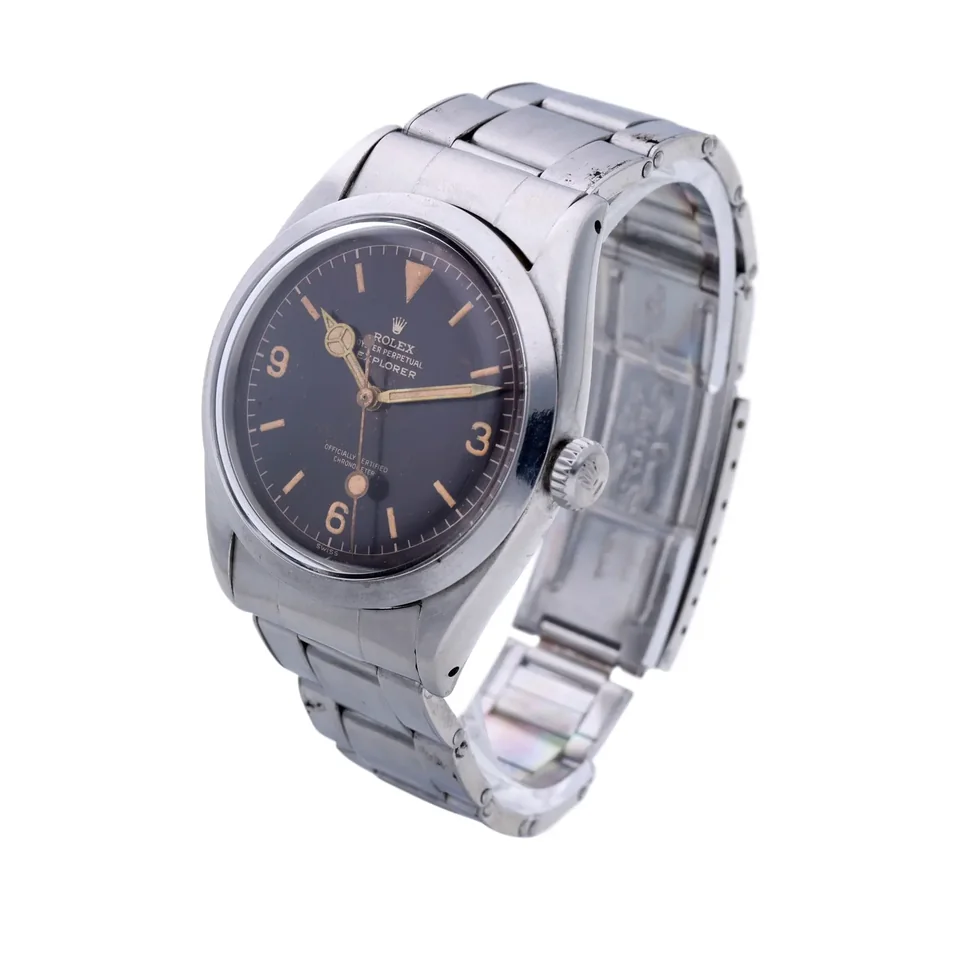
Other surviving watches have gilt-colored depth text or different printing characteristics. Auction records also show examples whose black dials have aged toward brown—often called “tropical” by collectors. That brown appearance is an aging result, not the original factory dial color.
This variety is exactly why the phrase “Explorer 6610 dial” is not enough to establish correctness. A buyer should compare the dial type, printing, luminous material, hands, serial range and case details as one complete watch. A feature that is correct on one 6610 may be wrong for another.
What collectors should examine
### 1. The case and reference identity
Confirm that the reference markings, serial range and physical case correspond to a 6610. Look closely at lug thickness and symmetry. Heavy polishing can soften the original geometry even when the watch remains genuine.
### 2. The dial—not just the color
Study the coronet, minute track, 3-6-9 numerals, lower-dial chronometer text and any depth inscription. A valuable-looking “tropical” tone should be evaluated for natural aging rather than accepted from a seller’s description alone.
### 3. Hands and luminous material
The hands and dial lume should be evaluated together. Matching color by itself does not prove originality; restoration can be intentionally color-matched. Uneven aging is not automatically a problem, either. Inspection under magnification and ultraviolet light may help an experienced specialist form an opinion, but no single test is conclusive.
### 4. The movement
The correct movement family is central to the reference. A qualified watchmaker should inspect the calibre, movement condition and signs of replacement or incorrect parts. The watch’s service needs can be significant even when it is running.
### 5. The bracelet and accessories
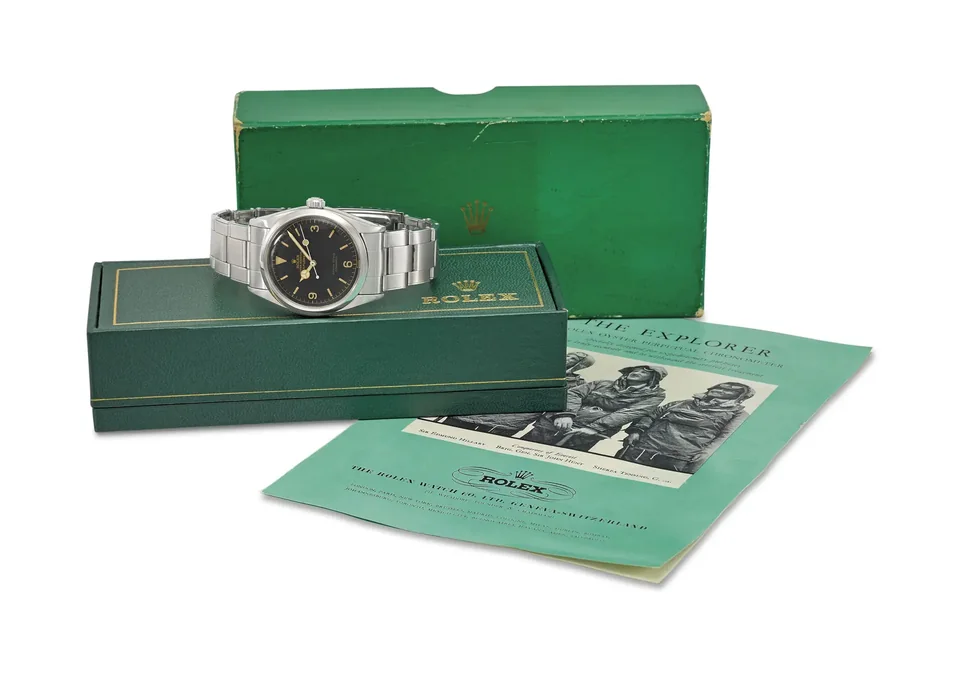
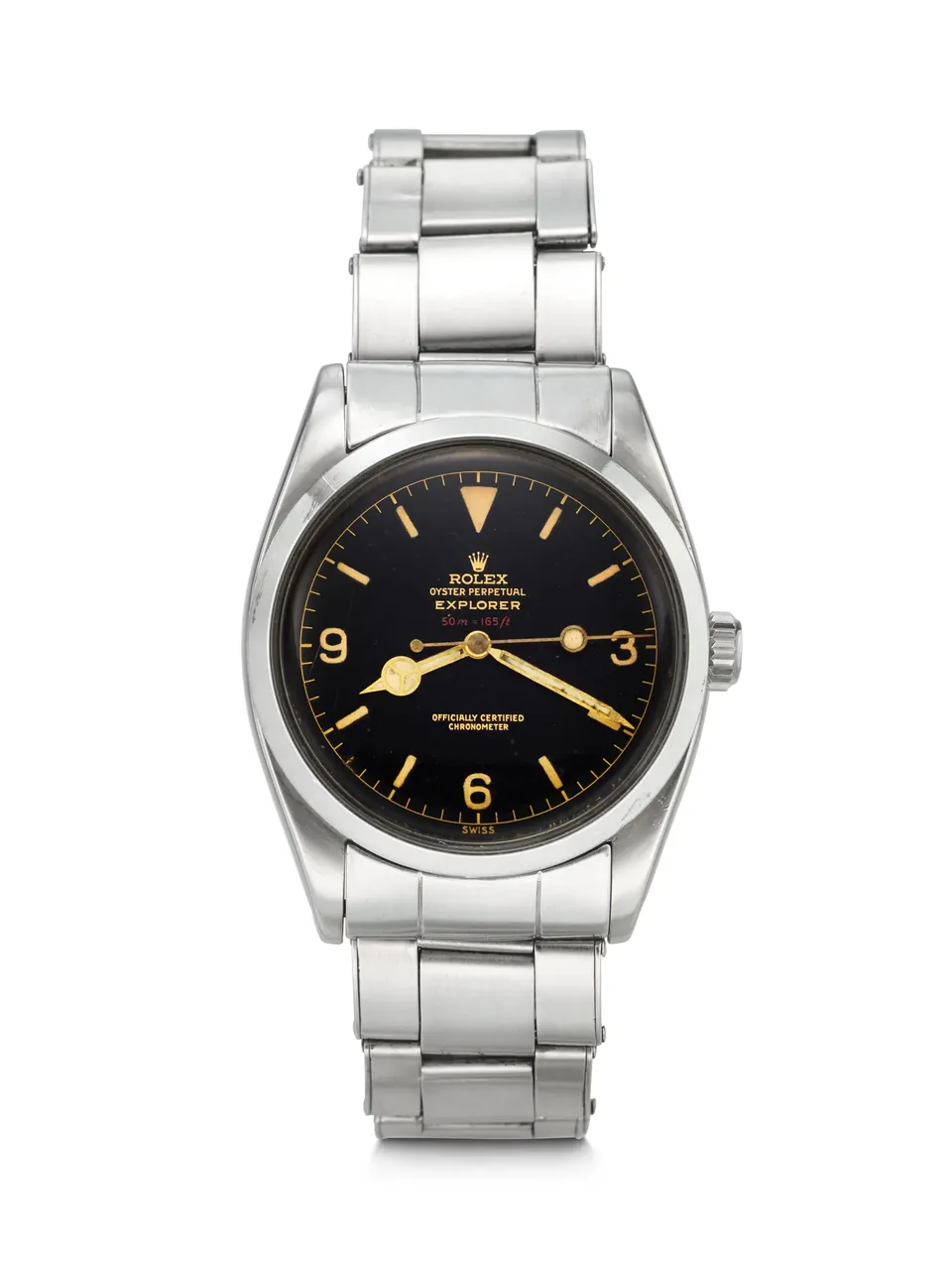
Vintage bracelets may have been replaced, repaired or paired with a watch later in its life. End-link and clasp information can help establish period compatibility, but a bracelet should be judged separately from the head of the watch. Boxes, papers and receipts strengthen provenance only when their details connect convincingly to the watch.
A better way to buy a 6610
The safest buying process starts with provenance and condition, not a nickname or a single rare feature. Request sharp, unedited photographs of the dial, case profile, space between the lugs, case back, crown, movement and bracelet. Ask for the case and movement numbers, service history, known replacement parts and a written return policy.
Because the 6610 is a valuable vintage reference with several recognized dial executions, an independent examination by a respected vintage Rolex specialist is appropriate before a final, non-returnable purchase. The goal is not merely to decide whether the watch is “real.” It is to understand which parts are original, period-correct, replaced, restored or altered—and to price the watch accordingly.
The Rallo take
The Explorer 6610 is appealing because its importance is quiet. It does not rely on a rotating bezel, date window or complicated function. Its significance comes from proportion, legibility and the transition to calibre 1030—the combination that helped shape the Explorer for the decades that followed.
A strong example should be judged as a complete historical object. Originality, condition and coherent provenance matter more than chasing one dramatic dial trait.
Sources reviewed
- Rolex, Explorer: A Real-World Laboratory — official account of the 1953 Everest expedition and the Explorer’s launch.
- Phillips, Rolex Explorer reference 6610, The New York Watch Auction: EIGHT — introduction in 1955, calibre 1030, flatter case profile and a documented 36 mm example.
- Phillips, Rolex Explorer reference 6610, The Geneva Watch Auction: EIGHT — a 1956 “Red Depth” example, calibre 1030 and comparison with earlier A296-equipped cases.
Facts checked September 8, 2026. Vintage specifications and dial details can vary by production period and individual watch; every example requires its own examination.