Vacheron Constantin Reviews · October 11, 2026
Vacheron Constantin Overseas Chronograph 49150/B01A-9745 Review: Blue-Dial Buyer’s Guide
A buyer-focused review of the Vacheron Constantin Overseas Chronograph 49150/B01A-9745, with exact-reference owner photos, condition checks and provenance guidance.
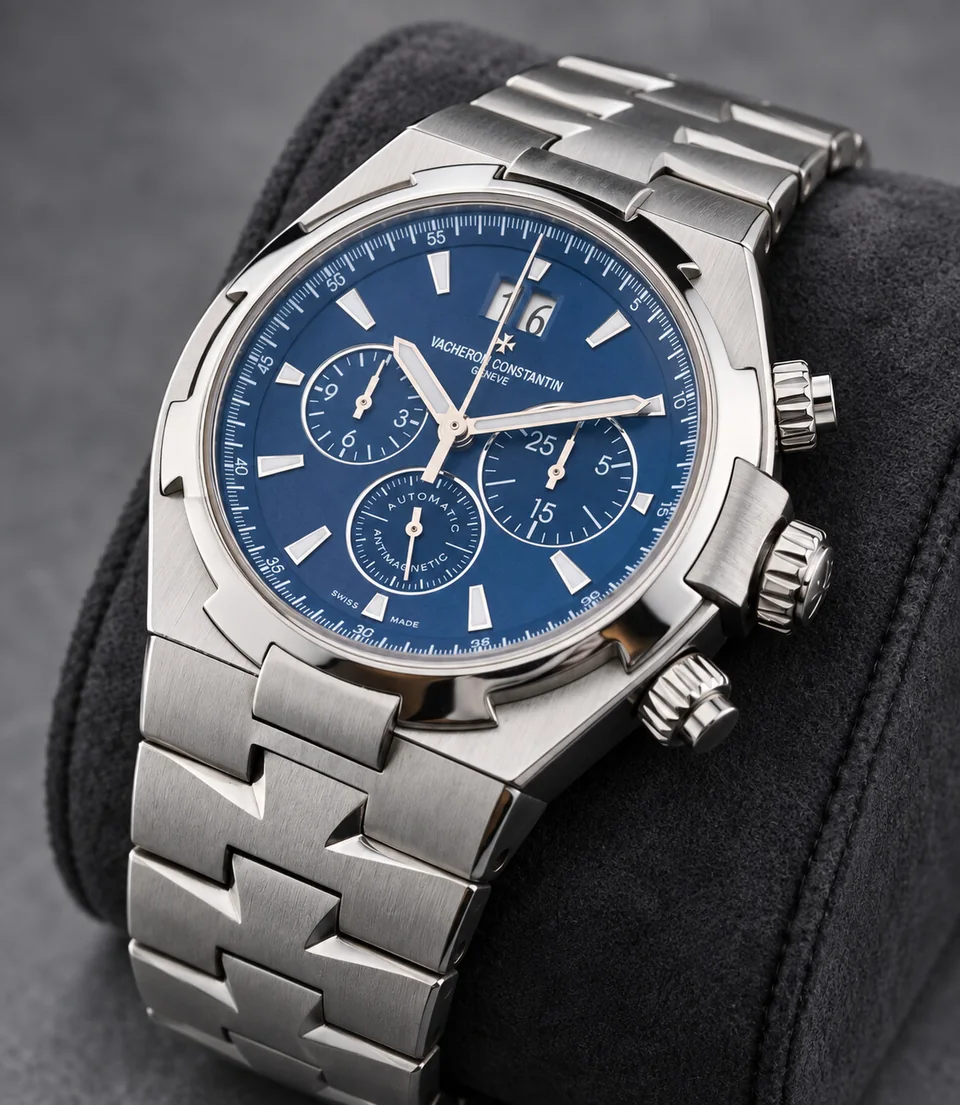
The Vacheron Constantin Overseas Chronograph reference 49150/B01A-9745 is a watch that rewards a slower inspection than its blue dial initially invites. The first impression is color and architecture: a deep blue dial, a large double-window date at 12, three registers, a steel case, and a bracelet whose links echo the Maltese cross. The more useful buyer’s view begins after that first impression—at the chronograph controls, case geometry, bracelet, documentation and service history.
The owner-archive records accompanying the exact watch photographed here identify it as reference 49150/B01A-9745. Those private records were used to confirm the subject but are not reproduced because identifying details belong in a confidential transaction file. The six published photographs show this same blue-dial, steel-bracelet configuration from the front, at an angle, from the underside and at the clasp.
This is an editorial review, not a sale listing or a substitute for authentication. A buyer should verify the watch itself and reconcile its reference, movement, dial, bracelet and records through a qualified inspection.
Why this generation of Overseas matters
Vacheron Constantin says the Overseas collection began in 1996 as a travel-oriented sports-watch line. The Maison’s own history notes a 2004 redesign that brought a more assertive form and integrated the Maltese-cross motif into the bracelet; the current generation followed in 2016. Reference 49150 belongs to that middle chapter, and the photographed watch makes the design change easy to understand.
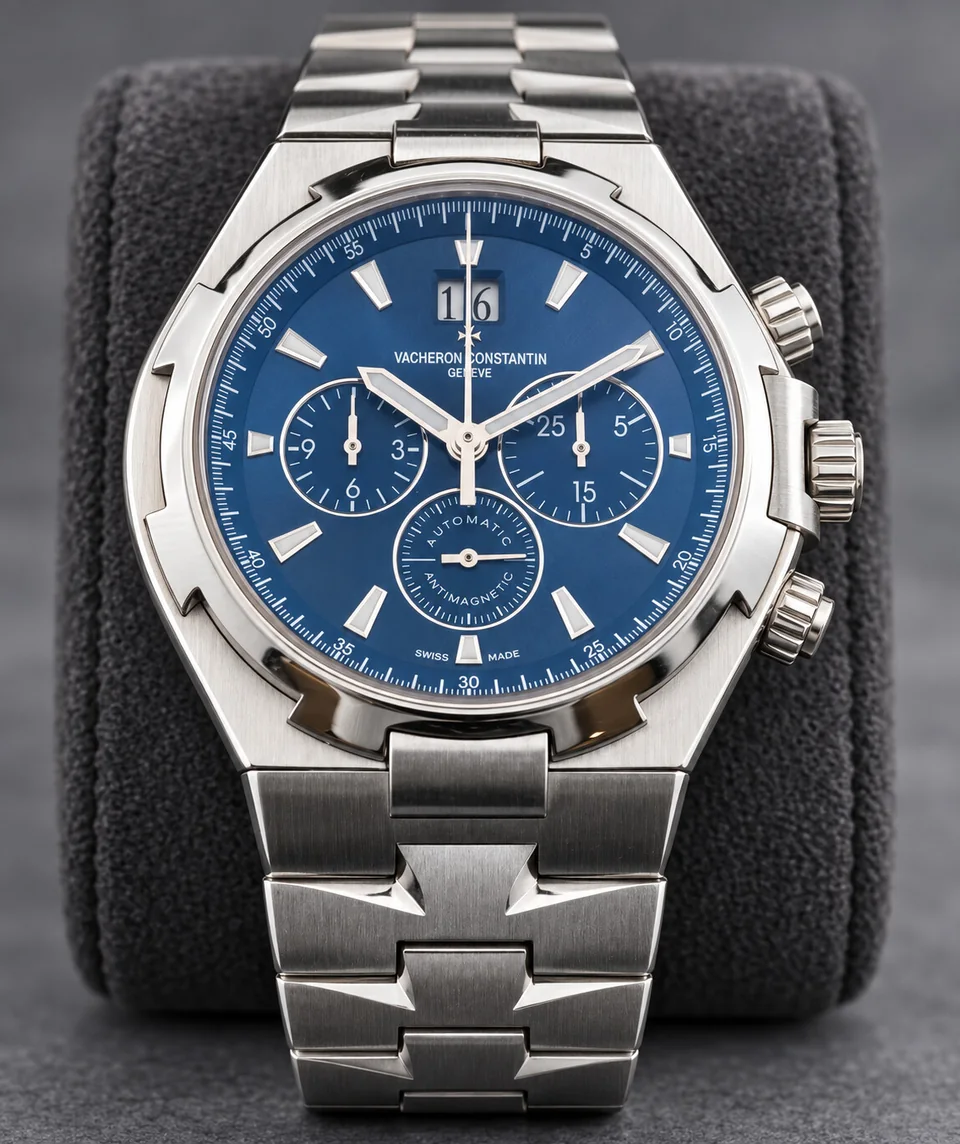
The bezel is not simply round. Its six notched sections create a strong visual rhythm with the case and bracelet. Brushed steel across the upper case and links is interrupted by polished edges that catch light without turning the whole watch into a mirror. On the bracelet, the recurring cross-shaped openings give the design its identity even when the dial is hidden.
That coherence is the principal appeal. The case, bezel and bracelet do not look like three unrelated components assembled around a movement. They read as one object.
Reading the blue chronograph dial
The blue dial carries a lot of information but remains orderly. A double-window date sits at 12 o’clock. The chronograph counters occupy 3 and 9, while the running-seconds register sits at 6. Applied luminous markers point toward a clearly printed outer track, and the broad hands remain legible against the blue surface.
The dial also gives a buyer several practical inspection points:
- Check that the two date discs sit level and advance cleanly.
- Start, stop and reset the chronograph repeatedly, confirming that every hand returns precisely to zero.
- Inspect the applied markers and hands under magnification for corrosion, scratches or signs of removal.
- Compare the printing, register texture and lume color across the whole dial rather than judging a single macro photograph.
- Confirm that the crown and pushers operate smoothly without forcing them.
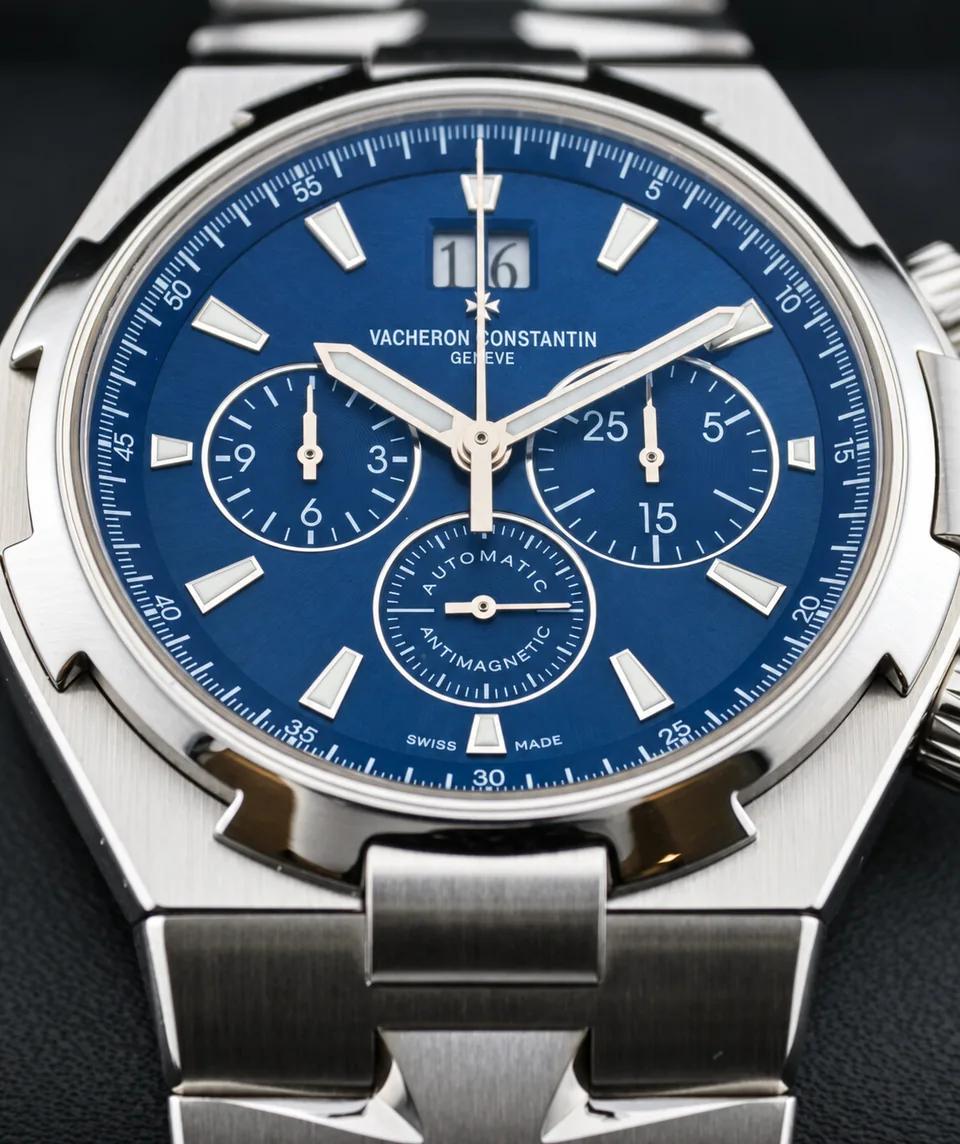
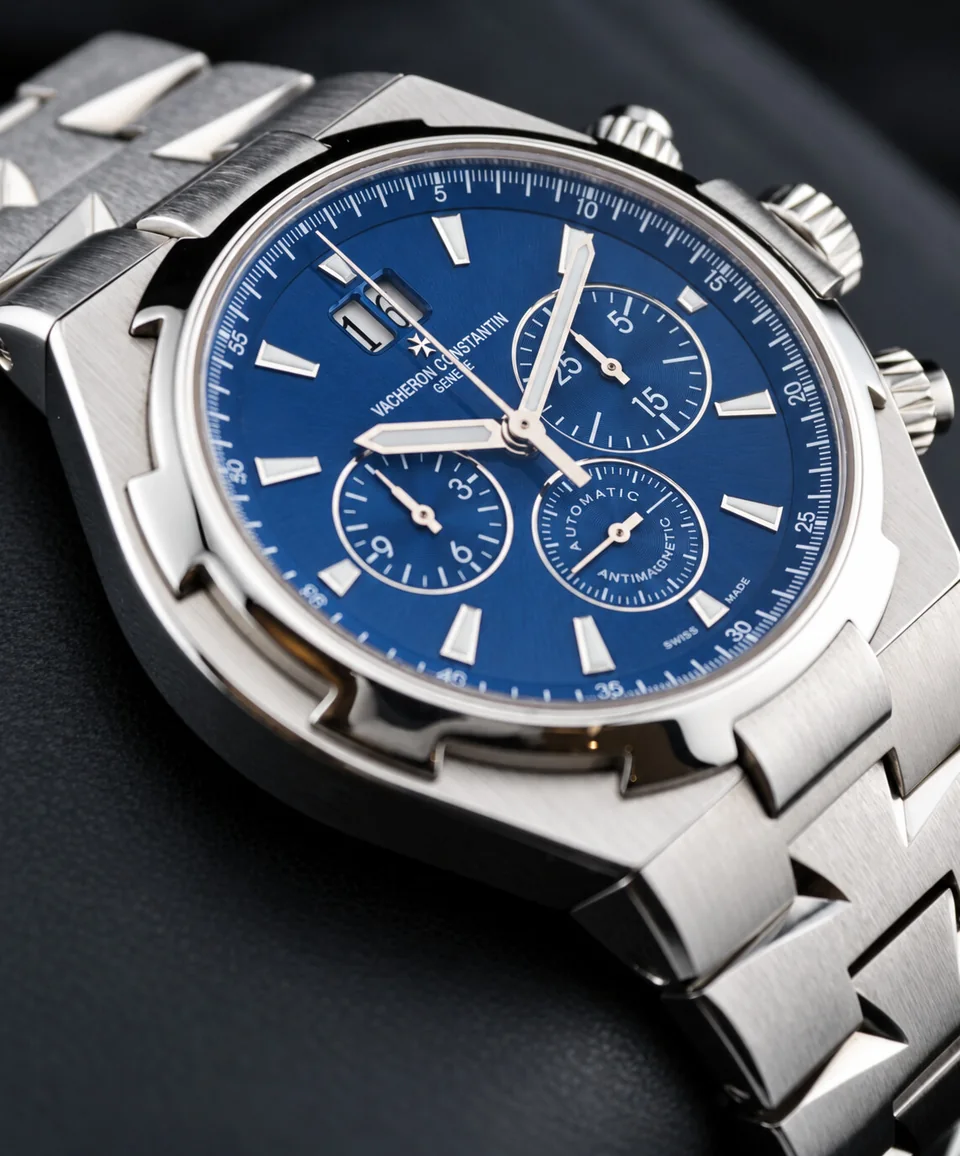
The blue finish changes noticeably with angle. The front macro shows a saturated, even field; the angled views reveal how the dial can move from bright royal blue to a darker, almost ink-like tone. That visual range is a major part of the reference’s appeal, but it also means a buyer should request photographs under neutral light. Heavy contrast or aggressive color correction can conceal surface issues.
Case, bracelet and clasp: inspect the geometry
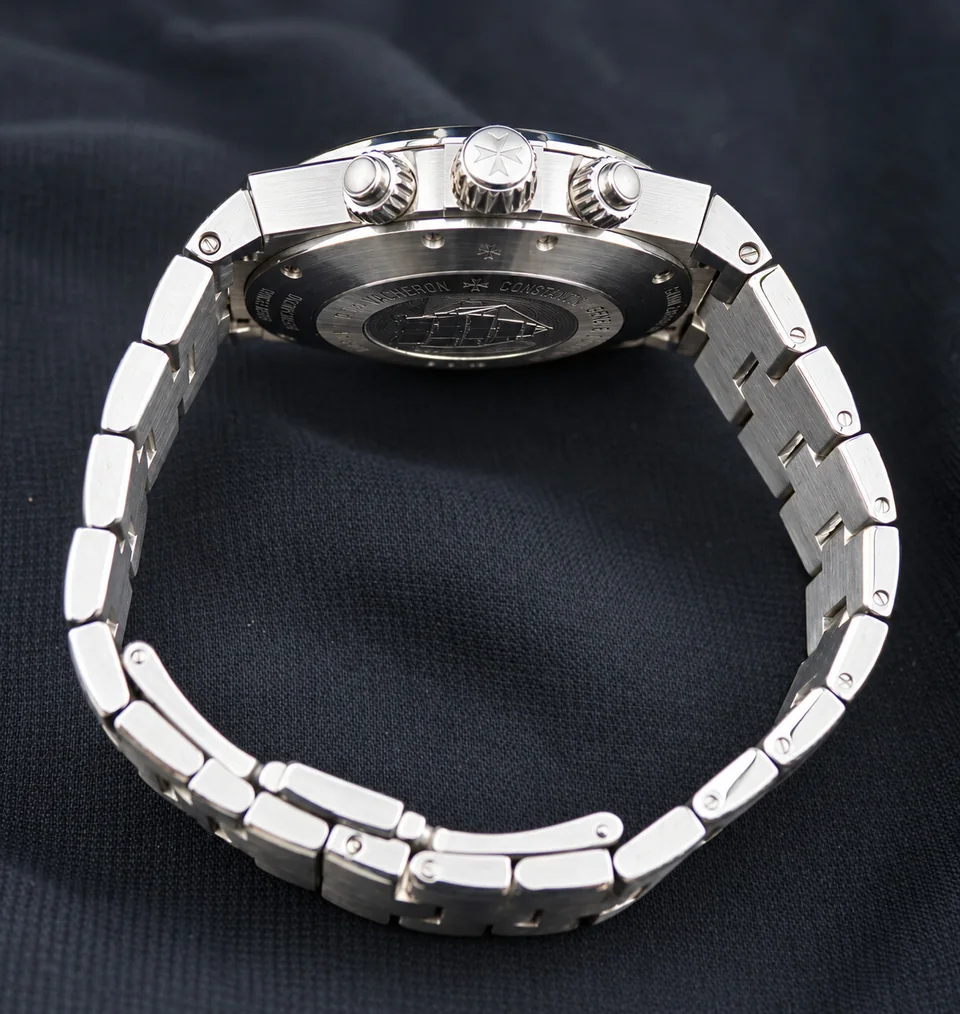
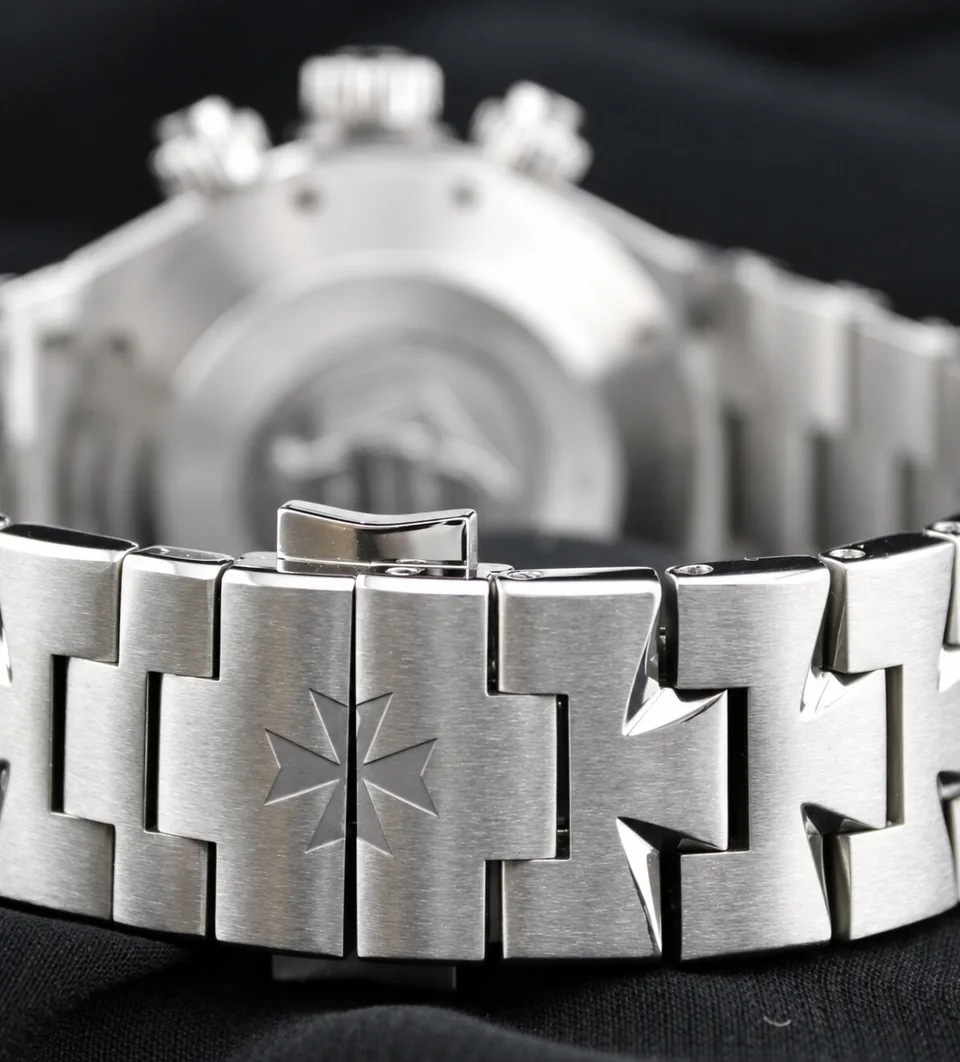
The strongest photographs in this set are not only the glamorous ones. The underside view shows the solid engraved caseback, bracelet articulation and the relationship between the crown, pushers and case flank. The clasp photograph isolates the brushed finishing and Maltese-cross emblem.
Look closely at the boundary between brushed and polished surfaces. Repeated refinishing can soften edges, make the bezel less crisp and round off the bracelet’s characteristic shapes. A clean-looking watch is not automatically a better watch if the original geometry has been reduced to achieve that appearance.
For the bracelet, inspect:
- lateral movement and articulation across every link;
- screw heads and evidence of careless tool use;
- the clasp blade, locking action and safety components;
- removable links and the fit of the bracelet to the case;
- consistency of brushing across adjacent links; and
- polished bevels for symmetry rather than maximum shine.
The photographed example presents sharply defined link shapes and clear surface transitions. That is an observation from these images, not a condition grade. A hands-on inspection under diffuse light remains the better test.
The paperwork question
A luxury sports chronograph can arrive with a convincing box and a stack of documents that do not all belong together. Treat each item as evidence to be reconciled, not decoration that automatically proves the watch.
Compare the technical reference and identifying numbers on the watch with the guarantee papers, service invoices and any archive material. Keep serial numbers private when sharing photographs. Ask whether the bracelet, dial, hands, crown and pushers were delivered with the watch or replaced during service.
Vacheron Constantin offers two different heritage documents, and the distinction is important. The Maison says an Extract from the Archives records original characteristics and historical information but is not a certificate of authenticity. A Certificate of Authenticity requires physical examination by its Heritage Department. Buyers should not use the two terms interchangeably.
For eligible watches from 2019 onward, Vacheron Constantin also describes a Digital Passport intended to hold key information and support ownership transfer. If a seller claims one is included, verify access and transferability rather than accepting a screenshot.
Service history matters more than a polished sales description
A chronograph combines more functions and more user-operated components than a simple time-only watch. “Runs well” is not enough. A proper pre-purchase examination should test amplitude, rate stability, power delivery, date change, chronograph engagement and reset, pusher feel and water resistance.
Vacheron Constantin’s current repair description says its process begins with diagnostic checks for water resistance, magnetism and accuracy. During a complete intervention the calibre is disassembled and inspected, required parts are changed or adjusted, components are cleaned and lubricated, gaskets are replaced, and the finished watch is tested again. That provides a useful benchmark when reading a service invoice: ask which of those operations were actually performed and by whom.
Do not assume that a factory water-resistance specification still applies to a pre-owned watch. Vacheron Constantin advises against operating the crown or pushers when a watch is submerged or still wet and recommends periodic water-resistance checks. For this exact watch, obtain a current pressure-test result before swimming.
Cosmetic work deserves its own line in the service conversation. Ask whether the case and bracelet were refinished, whether laser work was used, and whether the owner requested preservation of original geometry. Mechanical service and cosmetic restoration are different decisions.
What to verify before buying a 49150/B01A-9745
A disciplined inspection should answer the following:
- Does the technical reference on the watch match the records for 49150/B01A-9745?
- Do the dial, hands, double date, bracelet and clasp correspond to the documented configuration?
- Does the chronograph start, stop and reset cleanly through multiple cycles?
- Do both date discs align, and does the calendar change correctly?
- Are the case, bezel and bracelet edges still well defined?
- Is bracelet articulation consistent, with all necessary links and hardware present?
- What service was performed, when, and which parts were replaced?
- Has the watch passed a recent water-resistance test?
- Can the seller provide a confidential view of identifying numbers and ownership documents?
- Would a manufacturer heritage document or physical authenticity examination resolve any remaining uncertainty?
These questions are more useful than a one-word condition label. They also reduce the risk of paying a premium for accessories that cannot be tied to the watch.
Where it fits among integrated-bracelet chronographs
The 49150 offers a different proposition from the more extroverted Audemars Piguet Royal Oak Offshore 26237ST. The Overseas is still substantial, but the rounded bezel opening, restrained typography and flowing bracelet make it easier to read as an all-purpose luxury watch.
It also contrasts with the Patek Philippe Aquanaut 5167/1A-001, whose identity comes from a simpler time-and-date layout and a much lighter visual footprint. Buyers comparing those watches should decide first whether they want chronograph complexity and a more architectural bracelet, not merely which brand carries more prestige.
Rallo’s buyer information guide explains the inspection-first approach used throughout these reviews.
Verdict
The Vacheron Constantin Overseas Chronograph 49150/B01A-9745 succeeds because its complexity feels integrated rather than added on. The blue dial, double date, chronograph registers, notched bezel and Maltese-cross bracelet all belong to the same design language. It is recognizably a luxury sports watch, yet it does not depend on another brand’s silhouette.
Its buying case is strongest when the documentation and physical watch agree. Confirm the exact reference, examine the chronograph and date functions, protect the case geometry from unnecessary refinishing, and insist on a current service and water-resistance picture. Done properly, the due diligence preserves what makes this generation appealing: a distinct, technically ambitious Vacheron Constantin with real presence and an identity of its own.
Primary sources checked October 11, 2026
Photography and rights
All six photographs are original images from Ron King’s Rallo Watches owner archive and depict this exact reference and configuration. Commercial publication by Rallo is authorized. The set includes a lead view, front dial macro, angled dial view, full frontal view, underside/caseback view and clasp detail. No manufacturer photography, stock imagery, AI-generated imagery or merely similar reference was used.