Rolex Reviews · October 14, 2026
Rolex Yacht-Master 40 126622 Slate Dial Review: The Details Worth Inspecting
A buyer-focused review of the slate-dial Rolex Yacht-Master 40 126622, using four original owner photos to examine bezel condition, bracelet fit, controls and service evidence.
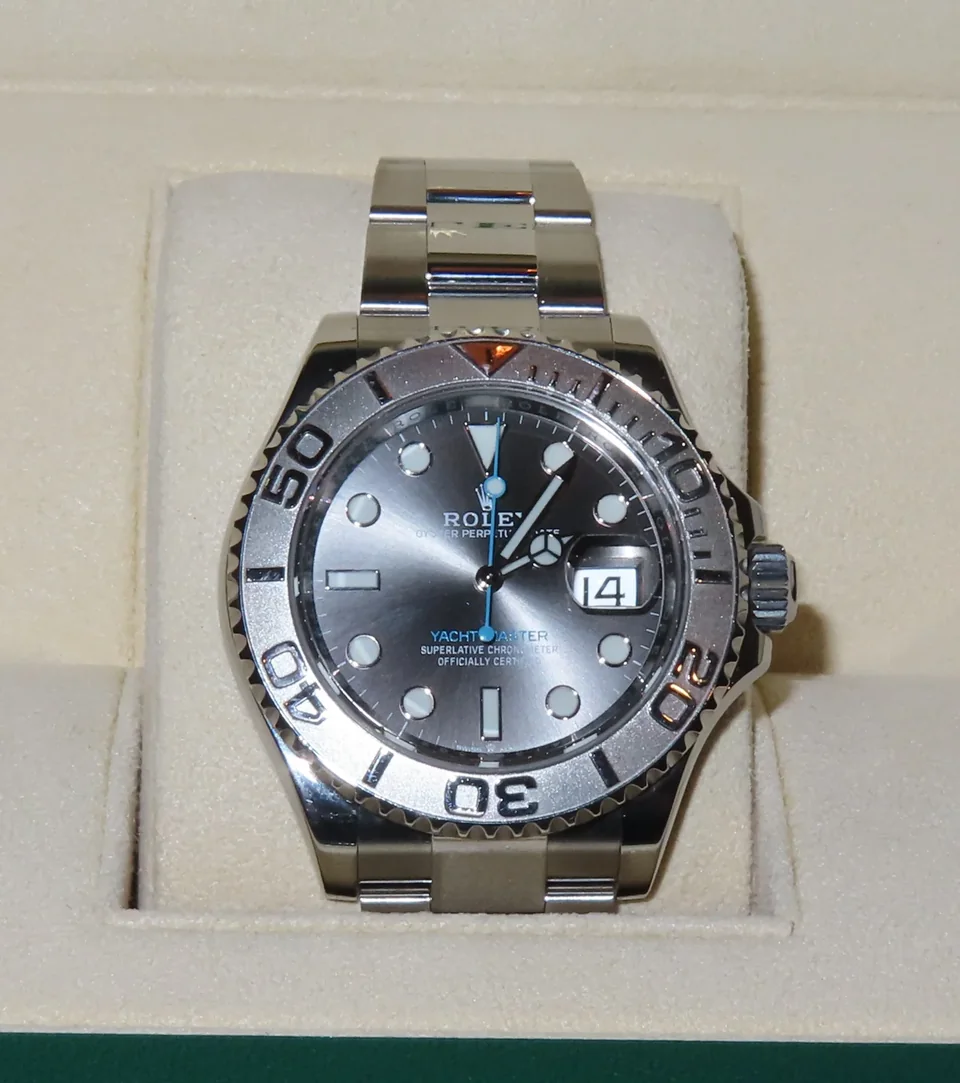
The Rolex Yacht-Master 40 reference 126622 makes its case through texture rather than a high-contrast color scheme. The slate dial, silver-toned bezel and steel bracelet sit close together visually; the bright blue seconds hand provides the interruption. In Ron King’s photographs, a small change in lighting makes the dial look cooler, warmer or darker without changing the watch itself.
This review concerns the slate-dial watch on its Oyster bracelet. The full reference was checked against a private warranty-card photograph, which is not included in the article. Four original owner photographs show the front, an oblique dial view, the crown-side case and the closed clasp. This is an editorial examination, not an offer of the photographed watch for sale.
What the photographs establish
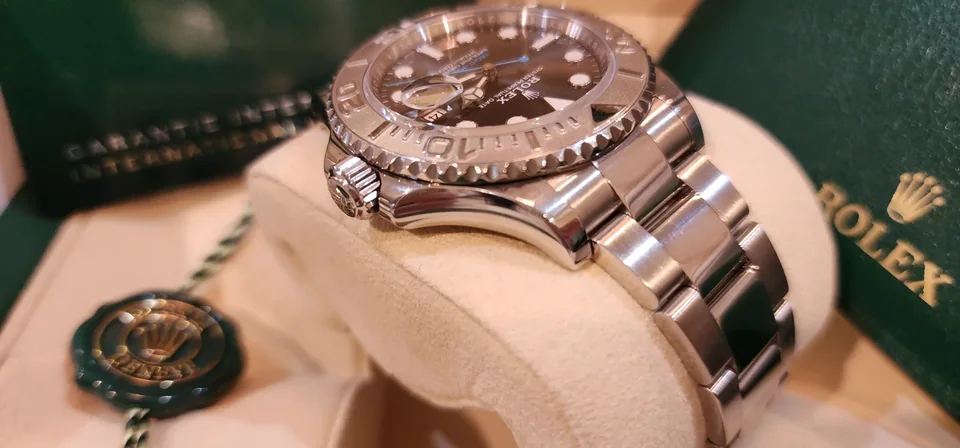
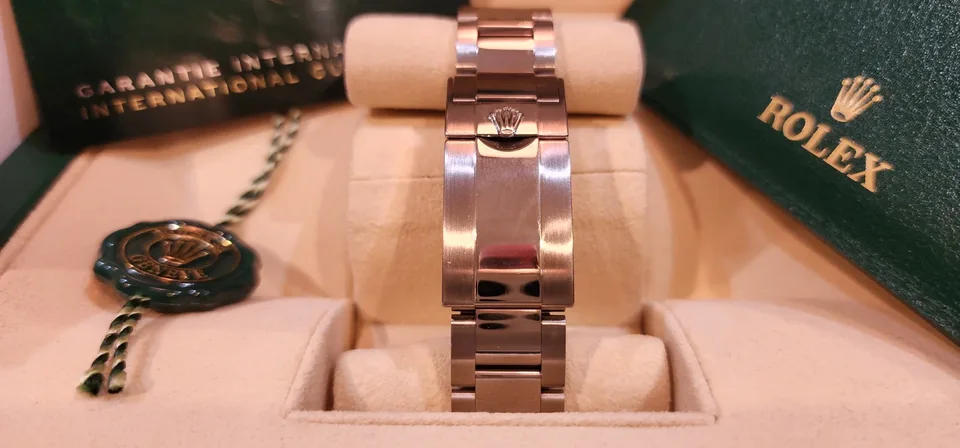
The frontal view shows the relationship between the dial, date magnifier and raised bezel numerals. The oblique view is useful for understanding reflections across the dial and polished surfaces. The case profile and clasp photograph answer different questions from another frontal shot.
These images identify features worth examining. They do not establish authenticity, prove that every component is original, demonstrate movement condition or certify water resistance. A buyer still needs the actual watch, reliable documents and an appropriate professional inspection.
Ron’s archive labels the dial “Rhodium.” Rolex’s current configuration page calls it “Slate.” For specification matching, Slate is the term used here. A descriptive folder label should not be mistaken for proof of a particular coating or material treatment.
The confirmed specification
Rolex identifies this configuration as reference 126622 in a 40 mm case, with an Oystersteel bracelet and a 950 platinum bezel. The manufacturer’s Rolesium designation describes the pairing of steel and platinum; it does not mean that the whole watch is platinum.
The current official specification lists automatic calibre 3235, approximately 70 hours of power reserve, a date display and 100-metre water resistance. Those are model specifications, not measurements of the photographed pre-owned example. Its current performance must be tested separately.
That distinction is important during comparison shopping. A reference number and an attractive photograph do not tell you how recently a watch was serviced or what work was done. Ask for documents that describe the individual watch rather than relying on a specification copied into a listing.
A bezel that deserves a close look
The graduated bezel is central to the Yacht-Master’s appearance. Rolex describes it as bidirectional, with raised 60-minute markings. The combination of the textured field and polished numerals gives an inspection several surfaces to consider.
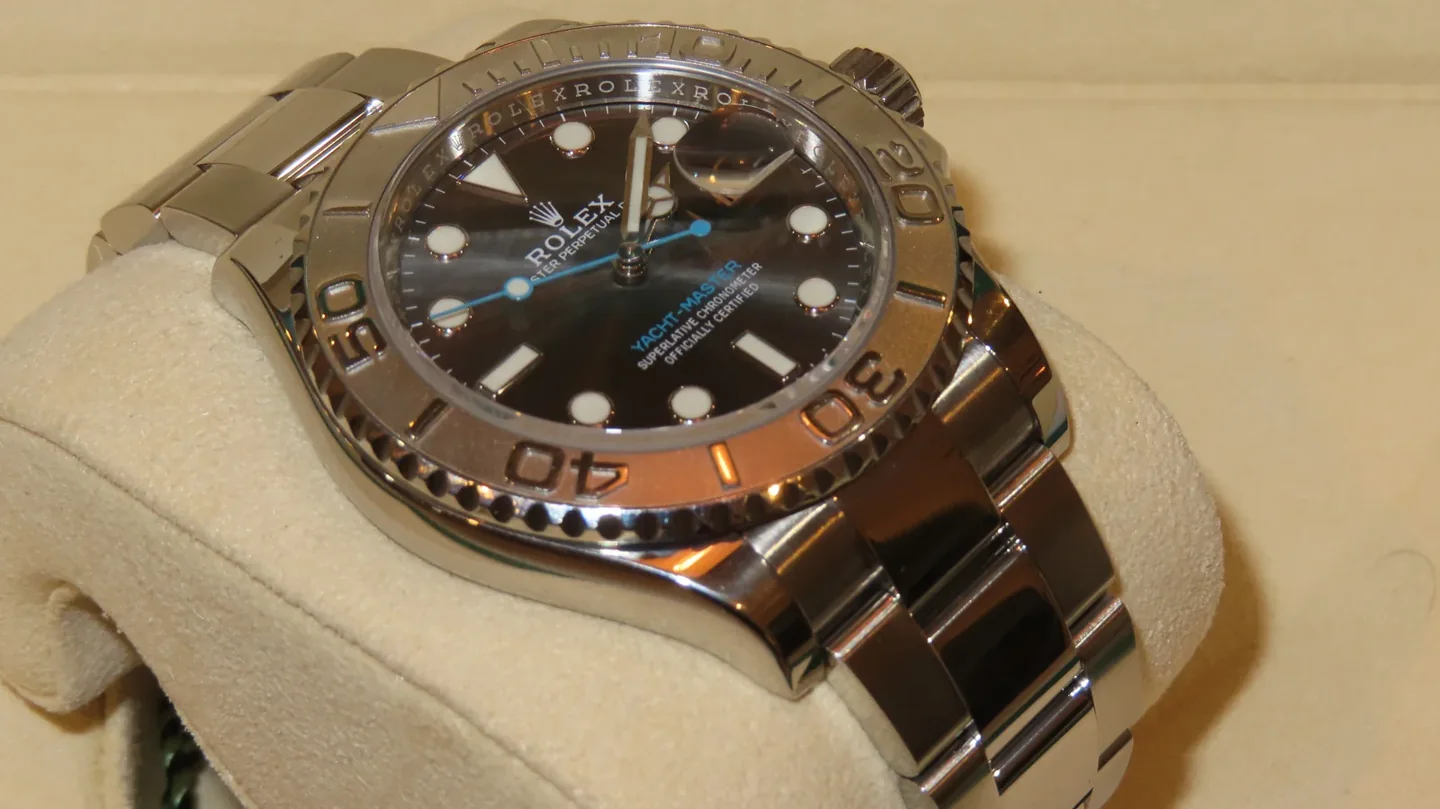
Look for dents, uneven edges, wear around the numerals and differences between the bezel and case finish. Ask the seller whether the bezel has been replaced or refinished. Do not infer an untouched case from bright reflections, or interpret every highlight in a photograph as damage.
Have the bezel demonstrated through its rotation and inspect it in more than one lighting condition. A photograph can conceal or exaggerate surface marks. The most useful response from a seller is a clear view and an accurate description, not an assurance that the watch looks perfect in one picture.
Bracelet fit is part of the purchase
The official configuration uses an Oysterlock safety clasp and an Easylink extension of approximately 5 mm. That adjustment is useful, but it does not replace the need for an appropriately sized bracelet.
Request the fitted circumference and a clear account of the links supplied with the watch. Confirm which links are installed and whether any removed links are included separately. A link count without a sizing method is not enough to promise that a bracelet will fit your wrist.
The clasp photograph shows the outside surfaces, not a complete functional test. Inspect how the clasp and safety catch open and close, and ask for a demonstration of the extension. Look at the screws, connections and underside as well as the polished center surfaces. Replacement or missing parts should be disclosed before a price is agreed.
What to ask about the movement
The practical inspection should include winding, time setting, date setting and a meaningful timing check. Ask whether the seller has tested power reserve and what the test actually involved. A photograph of a running seconds hand is not a timing report.
Rolex’s owner guide explains the crown positions and setting sequence. Follow the guide appropriate to the actual watch, including returning the crown to its secured position after use. If the crown feels rough, resists normal operation or has uncertain thread engagement, stop and have it examined rather than forcing it.
For service history, request the dated invoice and work description, together with details of replacement components. A claim that a watch was serviced is less useful than a record identifying the work performed. Where those records are absent, factor the uncertainty into your buying decision rather than treating a specification sheet as evidence of condition.
Water resistance is a current-condition question
The original rating should not be treated as a recent pressure-test result. If water use matters to you, obtain a current test through a suitable service provider and discuss any restrictions arising from the watch’s condition.
Rolex’s care guidance discusses cleaning and rinsing after saltwater exposure, with the crown secured. Apply those instructions to a watch whose seals and condition have been assessed, not as a substitute for that assessment.
Neither the case photograph nor the presence of a screw-down crown establishes the condition of the seals. A buyer should separate the model’s intended capability from what an individual pre-owned watch is currently ready to do.
Documents without public exposure
Compare the reference on the watch’s records with the watch being offered. Confirm the identity privately through a qualified inspection and the seller’s supporting documentation. Avoid circulating an unredacted warranty card or serial-number image publicly to obtain opinions.
Box contents, tags and booklets provide context, but they do not independently authenticate a watch or establish its ownership. Ask what is actually included, what belongs to the individual watch and whether the seller can support the relevant statements.
Rallo’s buyer information outlines the broader inquiry process. For another bracelet-focused Rolex examination, see the Daytona 116523 review. The Rallo Journal brings together the remaining reference and condition guides.
Verdict
The slate 126622 is worth considering when you want a watch whose visual interest comes from close inspection: dial reflections, bezel texture and the contrast between polished and brushed surfaces. The owner photographs show that character more honestly than a single idealized product image.
The buying decision should be just as specific. Verify the reference and configuration, inspect the bezel and case, establish bracelet fit, test the controls and obtain useful condition and service evidence. Choose the individual watch on those findings, not on the folder label or the reassurance of familiar branding.
Primary sources checked October 14, 2026
Photography and rights
Photographs: Ron King / Rallo Watches. Four original photographs from Ron’s personal owner archive show the same slate-dial, steel-bracelet Yacht-Master 126622. Camera metadata records capture on September 14, 2023, using Canon and Samsung cameras. Rallo’s public commercial reuse of Ron’s original photographs is authorized by his instructions to use his own archive. Compressed publication copies have camera and location metadata removed; no dial, bracelet, bezel or case features have been generated or replaced. The private warranty-card photograph used for reference confirmation is excluded from publication. No manufacturer gallery image, outside seller screenshot or AI-generated watch image is used.